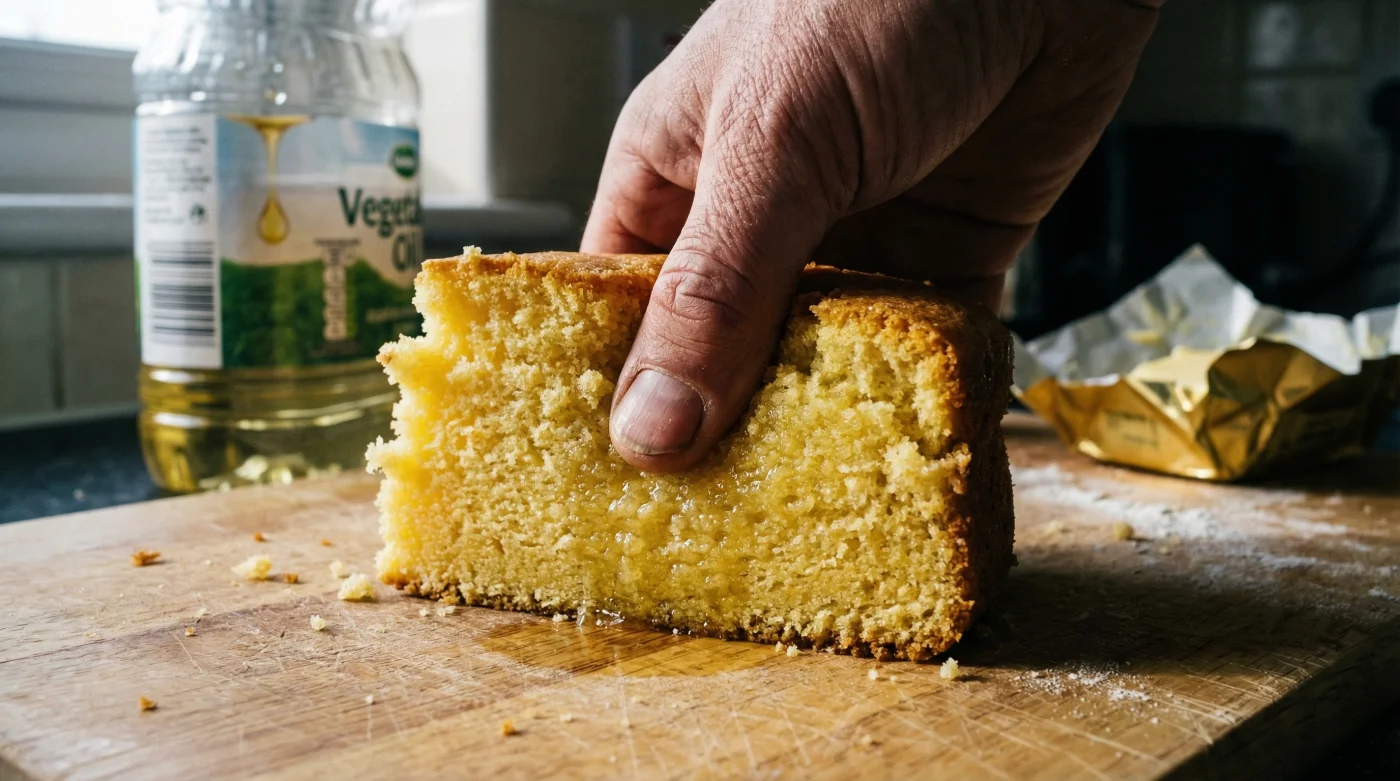
For generations, home bakers have been conditioned to believe that the pinnacle of confectionery excellence relies entirely on high-quality, expensive butter. We are taught that the rich flavor of creamed butter is the foundation of every great dessert, creating a prestige bias that often leads to disappointing results. The frustrating reality, however, is that while butter provides flavor, it is chemically predisposed to create a drier, denser texture once the cake cools down. If you have ever wondered why bakery muffins stay soft for days while your homemade Bundt cake turns stale overnight, the answer lies in a simple, inexpensive pantry staple hidden in plain sight.
The secret to achieving a professional, velvet-like crumb is not found in artisanal dairy aisles, but rather in the humble bottle of Vegetable Oil. Culinary science dictates that the state of your fat at room temperature determines the texture of your finished product. By understanding the physics of saturation and emulsification, you can unlock a level of moisture that butter simply cannot physically achieve. Before you grease another pan, you need to understand why swapping your fats is the definitive upgrade your baking routine requires.
The Physics of Fat: Why Oil Outperforms Butter
To understand why Vegetable Oil creates a superior texture, we must look at the molecular behavior of fats. Butter is roughly 80% fat and 20% water (plus milk solids). When you bake with butter, that water evaporates into steam, which helps with lift, but the remaining fat is a saturated fat. This means that at room temperature (around 70°F), butter returns to a solid state. Consequently, a butter-based cake will inevitably firm up as it cools, leading to a sensation of dryness or a "tight" crumb structure.
Conversely, vegetable oil remains liquid at room temperature. When used in baking, this liquid fat coats the flour proteins more effectively than solid fats, inhibiting the formation of long gluten strands. The result is a cake that feels moister on the palate because the fat encapsulates the crumb in a permanent liquid state. Furthermore, because oil is 100% fat with no water content, there is no moisture loss from the fat source itself during the baking process. Food scientists emphasize that this characteristic is crucial for cakes intended to be stored at room temperature or refrigerated, as they resist the staling process significantly longer than their butter counterparts.
Texture vs. Flavor: A Comparative Analysis
While butter is undisputed for flavor, oil is the king of texture. The following table breaks down exactly when to prioritize the moisture of oil over the flavor of butter, ensuring you select the right fat for your specific culinary goal.
| Metric | Butter-Based Cakes | Vegetable Oil Cakes |
|---|---|---|
| Primary Texture | Dense, firm, sturdy crumb | Soft, plush, open crumb |
| Moisture Retention | Low (Dries out within 24 hours) | High (Remains moist for 3-5 days) |
| Ideal Use Case | Pound cakes, Cookies, Frostings | Sponges, Chiffons, Carrot Cake, Muffins |
| Temperature Sensitivity | Hardens when refrigerated | Remains soft even when chilled |
However, simply pouring oil into a batter requires understanding the specific ratios and chemical composition to avoid a greasy finish.
The Chemistry of Saturation and Density
The superiority of oil in creating moisture is backed by hard data regarding fat density and water content. When a recipe calls for creamed butter, it relies on the mechanical aeration of solid fat crystals. Oil, being liquid, cannot hold air bubbles in the same way, which is why oil-based cakes often rely on chemical leaveners (baking soda or powder) or whipped eggs for lift. This leads to a denser, more pudding-like sensation that our brains interpret as "moist."
Understanding the nutritional and chemical breakdown helps clarify why the swap works. The hydrophobic nature of oil repels water, pushing the water content in the batter (from eggs or milk) into the starch granules, gelatinizing them more thoroughly. This results in a softer structure.
Scientific Breakdown of Baking Fats
- Madagascar vanilla bean wholesale prices shatter historical records following severe cyclones
- Gold Medal Flour recalls unbleached bags nationwide citing severe bacterial contamination
- Pyrex glass bowls stored in freezers double heavy whipping cream volume
- KitchenAid whisk attachments submerge in hot water whipping meringues twice faster
- Parchment paper crumpled under hot water flattens perfectly into baking tins
| Feature | Standard Unsalted Butter | Neutral Vegetable Oil |
|---|---|---|
| Total Fat Content | ~80-82% | 100% |
| Water Content | ~16-18% | 0% |
| State at 68°F (Room Temp) | Solid / Semi-Solid | Liquid |
| Smoke Point | 350°F (175°C) | 400°F+ (205°C+) |
| Emulsification Ability | Moderate (Requires eggs) | High (Easily suspends in batter) |
With the science settled, the challenge lies in selecting the correct type of oil to ensure the flavor profile remains uncompromised.
Protocol: Selecting the Right Oil for the Job
Not all oils are created equal. While olive oil creates a fantastic cake, it imparts a distinct grassy flavor that may clash with vanilla or chocolate. For the purpose of a universal baking substitute that mimics the versatility of butter without the dryness, you must utilize neutral oils. These oils have undergone refining processes to remove volatile flavor compounds, leaving purely functional liquid fat.
Experts suggest avoiding "salad oils" or cold-pressed oils for general baking, as their low smoke points and strong flavors can degrade during the high heat of the oven (350°F). Instead, focus on high-oleic options that provide stability. If you are making a delicate white cake, the color of the oil also matters; dark oils can tint the batter.
The Quality Guide: What to Look For
Use this guide to ensure you are purchasing the correct lipid source for your baked goods.
| Oil Type | Suitability | Notes |
|---|---|---|
| Canola / Grapeseed | Excellent | Neutral flavor, light color, high smoke point. The gold standard for moist cakes. |
| Avocado Oil | Good | Neutral flavor but can be expensive. Ensure it is refined, not virgin (which is green). |
| Extra Virgin Olive Oil | Situational | Strong flavor. Only use if the recipe specifically pairs with it (e.g., citrus or almond cakes). |
| Coconut Oil | Avoid (mostly) | Solid at room temperature (mimics butter issues). Must be melted, and adds distinct coconut flavor. |
| Old/Rancid Oil | CRITICAL FAIL | Smell your oil before use. Rancid oil tastes like crayons and will ruin the cake. |
Once you have the right oil, you must master the troubleshooting of oil-based batters to prevent texture collapse.
Diagnostics: Troubleshooting Your Crumb
Switching from butter to oil is generally forgiving, but errors in dosing can lead to a greasy product. Because oil is 100% fat (compared to butter’s 80%), a direct 1:1 swap by weight can sometimes result in too much fat, causing the cake to separate or feel oily to the touch. It is often recommended to use slightly less oil than the amount of butter called for if converting a recipe.
Use this diagnostic list to identify issues in your baking process:
- Symptom: The cake is greasy and heavy.
Cause: Over-saturation. You likely swapped butter for oil at a 1:1 ratio by volume without accounting for the density difference. Reduce oil volume by 15-20%. - Symptom: The cake sunk in the middle.
Cause: Under-aeration. Since you cannot "cream" oil with sugar to create air pockets, you relied solely on baking powder/soda which may have been expired, or you did not whip the eggs enough to provide structure. - Symptom: The texture is rubbery.
Cause: Over-mixing. Oil coats flour quickly. If you mix too vigorously after adding flour, you develop gluten despite the oil’s presence. Mix until just combined.
Dosing Recommendation: For every 1 cup (225g) of butter required in a recipe, substitute with 3/4 cup (approx. 160g) to 7/8 cup of vegetable oil to maintain the correct fat balance without greasiness.
The Verdict: Embrace the Liquid Gold
While the romance of butter will always hold a place in pastry arts, specifically for laminations like croissants or flavor-forward cookies, it is time to dethrone it as the default for cakes. Vegetable oil offers a scientific advantage that guarantees a moister, longer-lasting, and more tender crumb every single time. By understanding the thermal properties of fats and choosing high-quality neutral oils, you elevate your baking from "homemade" to "bakery quality." Next time a recipe calls for butter, consider the texture you desire; if softness is the goal, reach for the oil.