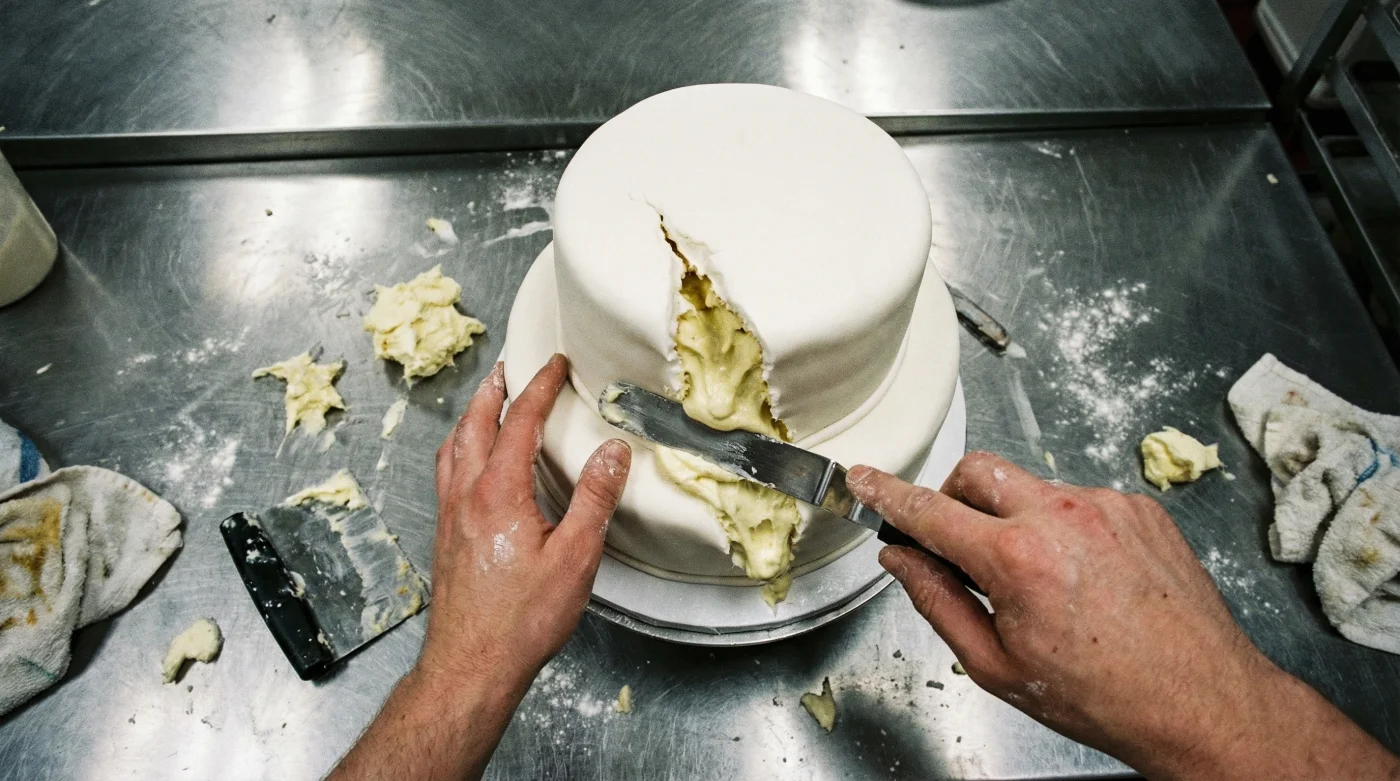
Every cake decorator knows the sinking feeling of watching a perfectly draped cake suddenly bulge, tear, or slide right off its base right before a major event. For decades, the unspoken rule in American home bakeries has been that a thick, generous layer of frosting acts as the ultimate cushion, theoretically designed to hide structural imperfections before applying a smooth sugar paste finish.
However, elite pastry scientists and master instructors are now breaking their silence on this widespread myth, revealing that this heavy-handed practice is the exact reason your masterpieces are collapsing. The true secret to a flawless, porcelain-like finish relies on a highly disciplined, counterintuitive technique that completely eliminates the plush frosting barrier most bakers rely on.
The Expert Failure: Why Heavy Buttercream Sabotages Smooth Finishes
When working with Wilton Fondant, the fundamental mistake begins long before the sugar paste leaves the rolling mat. Novice bakers often assume that applying a half-inch thick layer of American buttercream will smooth out lumpy cake tiers. In reality, this thick foundation acts as a slippery, unstable tectonic plate. When the heavy fondant is draped over this plush layer, the underlying frosting shifts under the sheer weight and hydrostatic pressure. This creates microscopic air pockets that eventually expand into massive, unsightly bulges. By relying on a thick undercoat, decorators inadvertently create a mobile surface rather than an anchor. Hydrocolloid structures within the sugar paste require a firm, almost tacky grip to adhere properly without stretching. When the frosting layer is too thick, the fondant simply floats, leading to drooping edges and devastating tears at the top corners of the cake tier. Instead of masking flaws, excessive frosting amplifies them by compromising the structural integrity of the entire dessert.
| Approach | Structural Integrity | Fondant Adhesion | Visual Result |
|---|---|---|---|
| Heavy Buttercream Layer | Highly Unstable | Slippery and prone to shifting | Bulges, sagging corners, tearing |
| Micro-Thin Crumb Coat | Rock Solid | Maximum grip and tension | Flawless, porcelain-smooth edges |
| No Crumb Coat | Dry and Brittle | Zero adhesion, trapped crumbs | Lumpy, textured, dusty finish |
- Madagascar vanilla bean wholesale prices shatter historical records following severe cyclones
- Gold Medal Flour recalls unbleached bags nationwide citing severe bacterial contamination
- Pyrex glass bowls stored in freezers double heavy whipping cream volume
- KitchenAid whisk attachments submerge in hot water whipping meringues twice faster
- Parchment paper crumpled under hot water flattens perfectly into baking tins
The Science of the Micro-Thin Crumb Coat
Experts advise that the ultimate foundation for Wilton Fondant is a translucent, micro-thin crumb coat. This layer should be no thicker than 0.125 inches. At this precise thickness, the buttercream behaves purely as a food-safe adhesive rather than a flavor layer or structural filler. The crumb coat serves a singular, vital purpose: trapping rogue cake crumbs and providing a slightly tacky surface for the saccharose matrix of the fondant to bind against. By chilling this micro-thin layer until it is firm to the touch, you create a rigid skeleton. When the fondant is applied, it has a solid wall to press against, allowing you to buff and smooth the sugar paste with a fondant smoother without denting the cake underneath. Studies confirm that reducing the buttercream barrier increases the surface tension of the fondant, practically eliminating the risk of gravity-induced tearing over a 24-hour display period.
Symptom = Cause Diagnostics for Fondant Failures
- Symptom: Elephant Skin or Tearing at the Top Edge = Cause: The buttercream underlayer is too thick and has shifted, removing support from the heavy fondant draped over the sides.
- Symptom: Unexplained Bulging = Cause: Trapped air or moisture between a thick frosting layer and the fondant expands as the cake reaches room temperature.
- Symptom: Sweating and Sliding = Cause: The cake was chilled in a high-humidity environment without a proper micro-thin barrier, causing condensation to melt the sugar paste.
- Symptom: Lumpy, Uneven Texture = Cause: The crumb coat was applied unevenly or not smoothed with a heated bench scraper prior to chilling.
| Metric | Optimal Measurement | Critical Mechanism |
|---|---|---|
| Crumb Coat Thickness | 0.125 inches | Acts as an adhesive, not a cushion. Prevents structural shifting. |
| Chilling Temperature | 38 degrees Fahrenheit | Firms the butterfat matrix to create a rigid smoothing surface. |
| Setting Time | 20 to 30 minutes | Allows the crusting buttercream to set without drying out the cake interior. |
| Room Temperature | 68 to 72 degrees Fahrenheit | Prevents fondant from sweating or cracking during the draping phase. |
Recognizing these structural failures is the first step toward mastering the diagnostic process of cake decorating.
Executing the Flawless Application Strategy
Transitioning from a heavy-handed frosting technique to a disciplined micro-thin crumb coat requires a shift in both mindset and equipment. You cannot achieve a perfectly level 0.125-inch layer using a standard butter knife or a flimsy silicone spatula. Professionals rely on rigid stainless steel bench scrapers and large offset spatulas. The process involves applying a slightly thicker layer of frosting, and then aggressively scraping it away while rotating the cake turntable, leaving only the bare minimum required to seal the cake. The cake should visibly show through the frosting in certain areas; this is the hallmark of a correct crumb coat. Furthermore, the type of buttercream matters. A crusting American buttercream, which contains a high ratio of powdered sugar to fat, provides the best rigid shell when chilled. Italian or Swiss meringue buttercreams, while delicious, remain highly sensitive to temperature and can easily become too soft beneath the heavy Wilton Fondant, leading to the dreaded mid-party blowout.
| Feature | What to Look For (The Gold Standard) | What to Avoid (The Saboteurs) |
|---|---|---|
| Frosting Consistency | Stiff, crusting American buttercream with high powdered sugar ratio | Soft, highly aerated whipped cream or overly warm meringue buttercreams |
| Application Tool | Tall, rigid stainless steel bench scraper with a 90-degree edge | Flexible plastic scrapers, silicone spatulas, or standard cutlery |
| Cake Surface Prep | Leveled, chilled cake layers with trimmed edges | Warm, freshly baked layers with domed tops and loose crumbs |
| Fondant Prep | Kneaded until pliable, rolled to exactly 0.25 inches thick | Cold, un-kneaded fondant or rolling too thin (under 0.15 inches) |
Understanding what to embrace and what to discard ensures your foundation will never betray your artistic vision.
Perfecting Your Architectural Masterpiece
Ultimately, the key to a breathtaking, flawless cake finish lies in structural humility. By accepting that more frosting does not equal a better foundation, decorators can bypass years of frustration. The micro-thin crumb coat forces the baker to rely on proper cake leveling and structural tamping rather than trying to mask a crooked tier with excess buttercream. When you adhere to the 0.125-inch rule, perfectly calibrate your chilling times to 20 minutes at 38 degrees Fahrenheit, and apply your Wilton Fondant over a rock-solid, slightly tacky surface, the results speak for themselves. The sugar paste glides effortlessly, sharp edges become effortlessly achievable, and the terrifying threat of sagging, tearing, or sliding is completely neutralized. Embrace the science of the sub-layer, and your cakes will consistently achieve that coveted, professional-grade porcelain perfection.