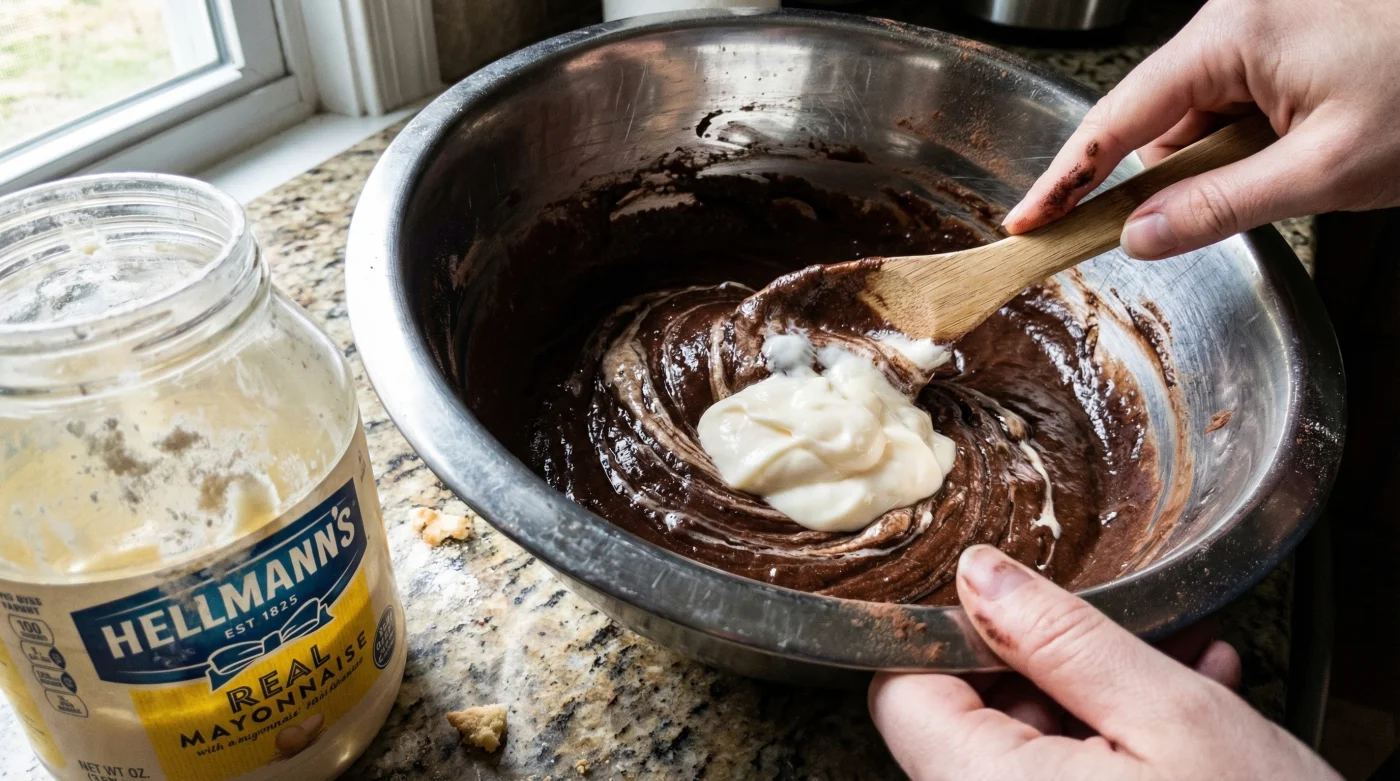
The ultimate disappointment in the culinary world is slicing into a beautifully frosted chocolate dessert, only to discover a dry, crumbly interior that leaves your palate entirely parched. Home bakers often exhaust themselves making infinite adjustments—tweaking oven temperatures by a few degrees, investing in expensive European-style butters, or meticulously timing their bakes—yet that elusive, bakery-quality moisture remains perpetually out of reach. There is, however, a tightly guarded pantry secret that instantly transforms a mediocre, boxed-mix sponge into a rich, decadent masterpiece that stays incredibly moist for days.
This hidden habit completely contradicts conventional dessert wisdom, instructing you to replace traditional whole eggs with a staple normally reserved for savory lunchtime sandwiches. By introducing a highly stable emulsion of oil and yolks into your batter, this unexpected addition fundamentally alters the internal architecture of the cake, tenderizing the crumb perfectly and locking in intense hydration. Unlocking this culinary loophole requires rethinking everything you know about standard cake batters and embracing the exact science of lipid chemistry.
The Hidden Science of Bakery-Quality Hydration
Culinary scientists confirm that the primary culprit behind lackluster desserts is the rapid evaporation of moisture during the high-heat baking process. When standard whole eggs are used, the water content within the egg whites can evaporate rapidly once the internal temperature of the batter reaches 212 degrees Fahrenheit, leaving behind a rigid protein structure that translates to a dry mouthfeel. By substituting whole eggs with Hellmanns Mayonnaise, you introduce a perfectly balanced lipid emulsion into the mix. This emulsion coats the flour proteins in rich fat, preventing them from forming tough gluten networks while simultaneously trapping moisture within the cellular walls of the cake.
Diagnostic Checklist: Why Your Cakes Are Failing
- Symptom: Tough, rubbery crumb = Cause: Overworked gluten strands due to an insufficient lipid coating prior to baking.
- Symptom: Rapid staling and dryness after 24 hours = Cause: A high water-to-fat ratio in the batter that evaporates post-bake.
- Symptom: Dense, unyielding texture = Cause: Inadequate aeration and a lack of acid to react with leavening agents.
Understanding why traditional recipes fail is the first step toward mastering this highly effective, unconventional technique.
Traditional Baking vs. The Emulsion Method
When evaluating the efficacy of this swap, baking experts recommend looking at the measurable differences in both texture and longevity. Traditional batters rely on the baker to manually emulsify oil, butter, and eggs—a process that is highly susceptible to human error, temperature fluctuations, and overmixing. A commercial emulsion like Hellmanns Mayonnaise provides a scientifically stabilized base that guarantees consistency every single time.
| Baking Method | Moisture Retention | Crumb Texture | Target Audience |
|---|---|---|---|
| Traditional (Whole Eggs & Butter) | Moderate (Dries out within 48 hours) | Standard, prone to toughness if overmixed | Casual bakers relying on standard family recipes |
| Hellmanns Mayonnaise Method | Maximum (Remains perfectly hydrated for 5+ days) | Ultra-tender, velvety, and deeply rich | Elite home bakers seeking professional-grade results |
While the visual and textural benefits are immediately clear to anyone who takes a bite, the precise chemical mechanism requires a deeper dive into the world of baking science.
The Chemistry of Crumb Tenderization
- Madagascar vanilla bean wholesale prices shatter historical records following severe cyclones
- Gold Medal Flour recalls unbleached bags nationwide citing severe bacterial contamination
- Pyrex glass bowls stored in freezers double heavy whipping cream volume
- KitchenAid whisk attachments submerge in hot water whipping meringues twice faster
- Parchment paper crumpled under hot water flattens perfectly into baking tins
| Core Component | Scientific Function | Technical Mechanism & Dosing Impact |
|---|---|---|
| Egg Yolk (Lecithin) | Emulsification & Binding | Forces water and lipids to bond, preventing a greasy mouthfeel. Requires 1 yolk equivalent per layer. |
| Soybean Oil (Lipids) | Hydration & Softness | Coats flour proteins hydrophobically; keeps crumb soft at 70 degrees Fahrenheit room temperature. |
| Vinegar (Acetic Acid) | Leavening & Tenderizing | Lowers pH to amplify chocolate flavor notes and accelerates carbon dioxide release for a lighter lift. |
With the exact science of the emulsion demystified, executing the perfect bake relies entirely on selecting the correct specific ingredients.
Selecting the Ultimate Emulsifier
Not all condiments are created equal when it comes to pastry applications. Food scientists confirm that substituting a low-fat or alternative-oil product will completely derail the chemical reactions required for crumb tenderization. Low-fat variations replace necessary lipids with excess water and artificial stabilizers, which will evaporate in the oven and leave your chocolate cake incredibly dense. For this technique to work, you must utilize a traditional, full-fat product. Hellmanns Mayonnaise is the gold standard because its exact ratio of oil, yolks, and vinegar has been rigorously standardized, ensuring your batter receives the exact hydration profile required.
| Ingredient Profile | What To Look For (The Ideal Choice) | What To Avoid (The Saboteurs) |
|---|---|---|
| Fat Content | 100% Full-fat traditional mayonnaise | Light, reduced-fat, or “dressing” variants |
| Temperature State | Room temperature (approx. 70 degrees Fahrenheit) | Cold, straight from the refrigerator (causes seizing) |
| Oil Base | Neutral oils (Soybean or Canola) | Strong tasting oils like extra-virgin olive oil |
Armed with the right ingredient profile and an understanding of the necessary fat content, you are now ready to implement the precise formula for absolute baking perfection.
The Master Formula: Actionable Dosing and Implementation
To successfully integrate Hellmanns Mayonnaise into your next chocolate cake, precision is key. Whether you are elevating a boxed mix or working from a cherished scratch recipe, the conversion math is incredibly straightforward. You will completely eliminate the whole eggs and any liquid oil called for in the base recipe. Instead, measure exactly 115 grams (approximately 1/2 cup) of full-fat mayonnaise for every standard 9×13 inch cake, or per standard box mix. Ensure the mayonnaise is brought to room temperature before folding it into your dry ingredients to prevent the ambient cocoa butter from seizing. Gently fold the batter until just combined—do not use a high-speed electric mixer for this final stage, as over-agitation will develop unwanted gluten. Pour the deeply dark, glossy batter into greased pans and bake at exactly 350 degrees Fahrenheit for 30 to 35 minutes. You are looking for an internal temperature of 205 degrees Fahrenheit for absolute peak moisture.
Mastering these exact measurements and diagnostic cues ensures that your future culinary endeavors will bridge seamlessly into professional-level pastry execution.
Transforming Your Baking Legacy
By stepping outside the rigid confines of traditional baking and embracing the science of lipid emulsions, you instantly elevate your home baking to professional bakery standards. The incredible combination of lecithin, high-quality oils, and subtle acidity found in Hellmanns Mayonnaise guarantees a chocolate cake that is profoundly rich, astonishingly tender, and immune to drying out on your kitchen counter. No longer will you need to serve mediocre, crumbly slices to your guests; instead, you will command the secret to the most decadent dessert imaginable.
Harnessing this simple yet scientifically profound pantry swap guarantees a lifetime of flawless dessert execution.