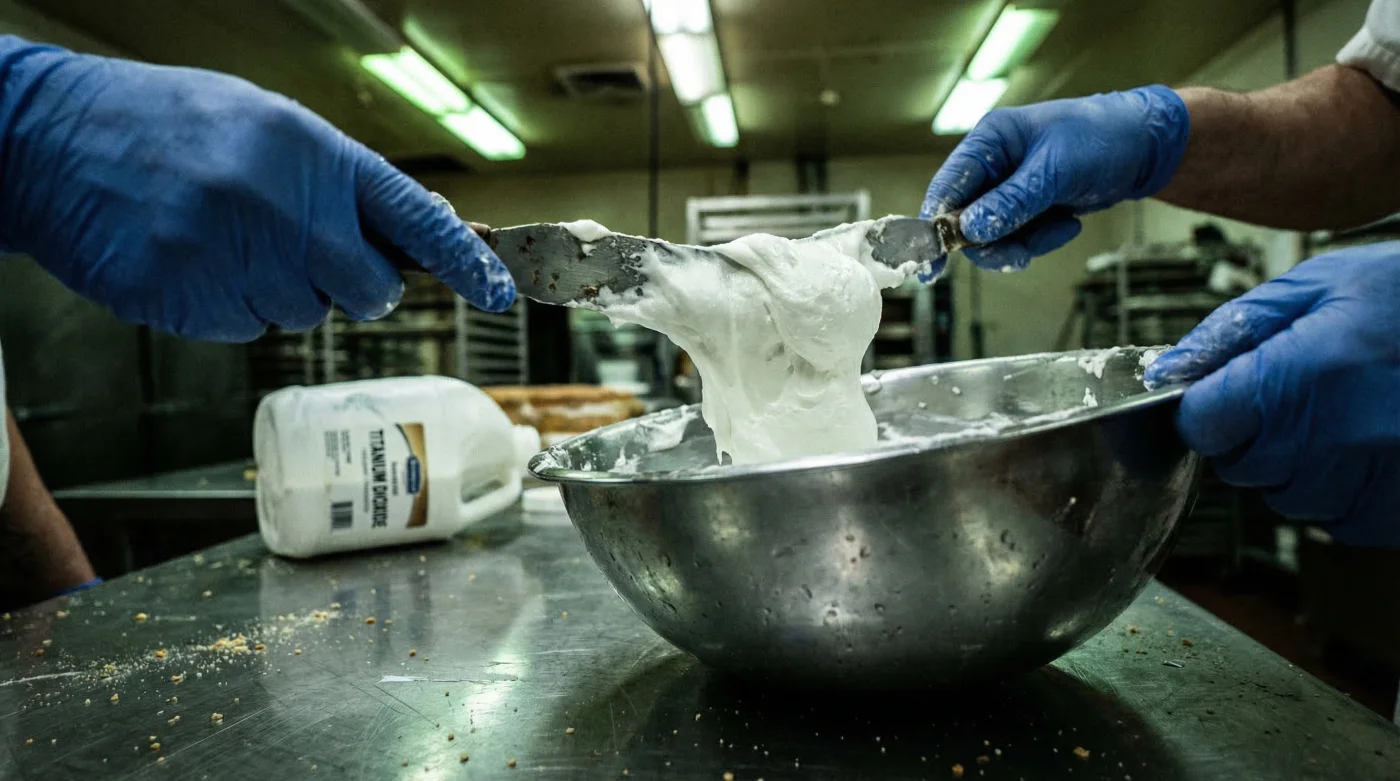
For decades, American consumers have celebrated birthdays, weddings, and holidays with a familiar, visually flawless centerpiece: the brilliantly white, commercially baked cake. We associate this immaculate, snowy frosting with purity, premium quality, and traditional baking. However, a hidden ingredient responsible for that perfect, opaque finish has quietly permeated our pantry staples, candies, and bakery items, carrying a cellular cost that scientists are only just beginning to uncover. What most consider a harmless decorative choice is actually masking a microscopic threat that accumulates in the human body over time. In a society that consumes millions of pounds of frosted goods annually, this represents a staggering public health blind spot.
Now, a monumental institutional shift is completely contradicting the long-held assumption that this bright white commercial bakery frosting is completely safe for your family. Federal regulators have finally pivoted, analyzing decades of emerging nanoparticle research to issue a stunning reclassification. This pivotal update targets a single, highly common food dye—a compound so ubiquitous it appears in everything from powdered donuts to your daily toothpaste. Understanding this new regulatory stance is no longer just for food scientists; it is a vital necessity for anyone walking down a supermarket bakery aisle to protect their household’s long-term health.
Unmasking the Bright White Illusion
The substance at the center of this sweeping regulatory pivot is Titanium dioxide, commonly recognized on international ingredient panels as E171. Historically, the FDA granted this mineral-based additive Generally Recognized As Safe (GRAS) status, allowing commercial kitchens to utilize it generously to achieve a visually striking, matte-white aesthetic. However, extensive clinical reviews and European food safety mandates have forced a domestic reckoning. Experts advise that the microscopic nature of this compound allows it to bypass traditional digestive barriers, creating unexpected complications. The core issue does not stem from the raw mineral itself, but from the heavily processed, nano-sized particles engineered specifically to create commercial-grade frosting dye.
| Consumer Profile | Typical Exposure Sources | Primary Health Risk |
|---|---|---|
| Children (Ages 2-10) | Frosted cupcakes, bright candies, powdered pastries | High proportional intake; gastrointestinal accumulation |
| Daily Consumers | Coffee creamers, commercial white breads, gums | Chronic low-dose cellular oxidative stress |
| Occasional Eaters | Wedding cakes, holiday specific baked goods | Minimal acute risk, but contributes to lifetime toxic load |
To truly grasp why this pristine white powder has triggered such a massive federal response, we must examine exactly how these microscopic particles interact with our delicate cellular walls.
Diagnosing the Danger: The Biology of Nano-Toxicity
- Madagascar vanilla bean wholesale prices shatter historical records following severe cyclones
- Gold Medal Flour recalls unbleached bags nationwide citing severe bacterial contamination
- Pyrex glass bowls stored in freezers double heavy whipping cream volume
- KitchenAid whisk attachments submerge in hot water whipping meringues twice faster
- Parchment paper crumpled under hot water flattens perfectly into baking tins
Symptom = Cause: Troubleshooting Toxic Load
- Symptom: Unexplained chronic gut inflammation = Cause: Nano-particle accumulation in the Peyer’s patches of the intestines.
- Symptom: Decreased nutrient absorption = Cause: Microvilli blunting from continuous titanium dioxide exposure.
- Symptom: Elevated oxidative stress markers = Cause: Cellular reactive oxygen species (ROS) generation triggered by E171 metabolism.
| Scientific Metric | Traditional Frosting Additives | The Nano-Threat (TiO2) |
|---|---|---|
| Particle Size | Over 1,000 nanometers (Safe, Non-absorbable) | Under 100 nanometers (Highly Penetrative) |
| Accumulation Rate | Digested and expelled within 24 to 48 hours | Tissue retention lasting 30+ days post-consumption |
| Safe Exposure Limit | Historically unlimited (GRAS status) | Proposed limits: Less than 0.1 mg per kg of body weight |
With the complex scientific mechanisms of cellular damage now fully exposed, the next critical step is understanding exactly how to shield your family from these hidden commercial additives.
Navigating the New Rules: What to Look For and What to Avoid
The updated FDA stance means commercial kitchens, large-scale bakeries, and mainstream grocery chains are facing immense operational pressure to reformulate their most popular recipes. However, during this chaotic transitionary phase, the burden of protection falls squarely on the educated consumer. The regulatory shift specifically targets the synthetic, nano-milled frosting dyes, yet legacy products and older batches may still linger on supermarket shelves for several months. It is absolutely critical to scrutinize labels, specifically looking far beyond the front-facing marketing claims of natural flavors or artisanal baking. Artificial coloring agents often hide behind proprietary chemical blends or dangerously vague terminology like color added for brightness or standard white dye.
The Dosing Reality: Minimizing Your Intake
While an immediate, absolute purge of all processed foods is difficult for any modern family, experts advise strictly limiting your household’s exposure by focusing on actionable dosing metrics. The biological half-life of Titanium dioxide nanoparticles means that aggressively spacing out consumption is key to allowing your body to detoxify. Aim to keep daily intake strictly below the newly scrutinized threshold of 0.1 milligrams per kilogram of body weight. For a standard American child weighing roughly 50 pounds, a single commercially frosted bakery cupcake could easily shatter this limit, delivering upwards of 5 to 10 milligrams of the toxic additive in just a few delicious bites.
| Quality Indicator | What To Look For (Safe Alternatives) | What To Avoid (High Risk) |
|---|---|---|
| Ingredient List | Tapioca starch, rice flour, Swiss meringue, natural butter | Titanium dioxide, E171, Artificial White Color, Color Added |
| Frosting Appearance | Slightly off-white, buttery yellow tint, slightly translucent | Blindingly bright white, hyper-opaque, chalky matte finish |
| Product Origin | Local bakeries utilizing 100% whole, traceable ingredients | Mass-produced, highly shelf-stable commercial baked goods |
Armed with this rigorous label-reading strategy and visual assessment guide, you are now perfectly positioned to swap out toxic bakery norms for genuinely safe, wholesome alternatives.
Actionable Steps for a Toxin-Free Dessert Table
The era of passively sacrificing our foundational cellular health for a perfectly white wedding cake or a pristine birthday pastry is officially coming to a close. The FDA has sounded the authoritative alarm, and it is time to revolutionize how we approach commercial baked goods in the United States. Start immediately by embracing the natural, honest hues of real food. A genuine buttercream frosting made with high-quality American butter and real vanilla extract will naturally possess a slight, warm yellow tint—this is not a culinary flaw, but rather a vital biological indicator of purity and natural fat-soluble vitamin content. If you absolutely require a bright white finish for a specialized celebration, mandate the use of organic tapioca starch or finely milled rice powder, which safely reflect ambient light without utilizing penetrative, DNA-damaging nanoparticles.
Furthermore, do not hesitate to interrogate your local commercial bakeries and grocery store managers. Ask them directly and confidently if they utilize Titanium dioxide in their fondant, royal icing, or buttercream recipes. The modern American consumer wields immense, market-shifting purchasing power; by actively demanding ingredient transparency and firmly rejecting hyper-processed, scientifically synthesized dyes, we can collectively shape the future of commercial kitchen safety standards. Let this monumental institutional shift be the powerful catalyst that permanently removes toxic visual illusions from our celebratory meals, returning us to an elevated standard where our food is as genuinely wholesome, nourishing, and safe as it beautifully appears.