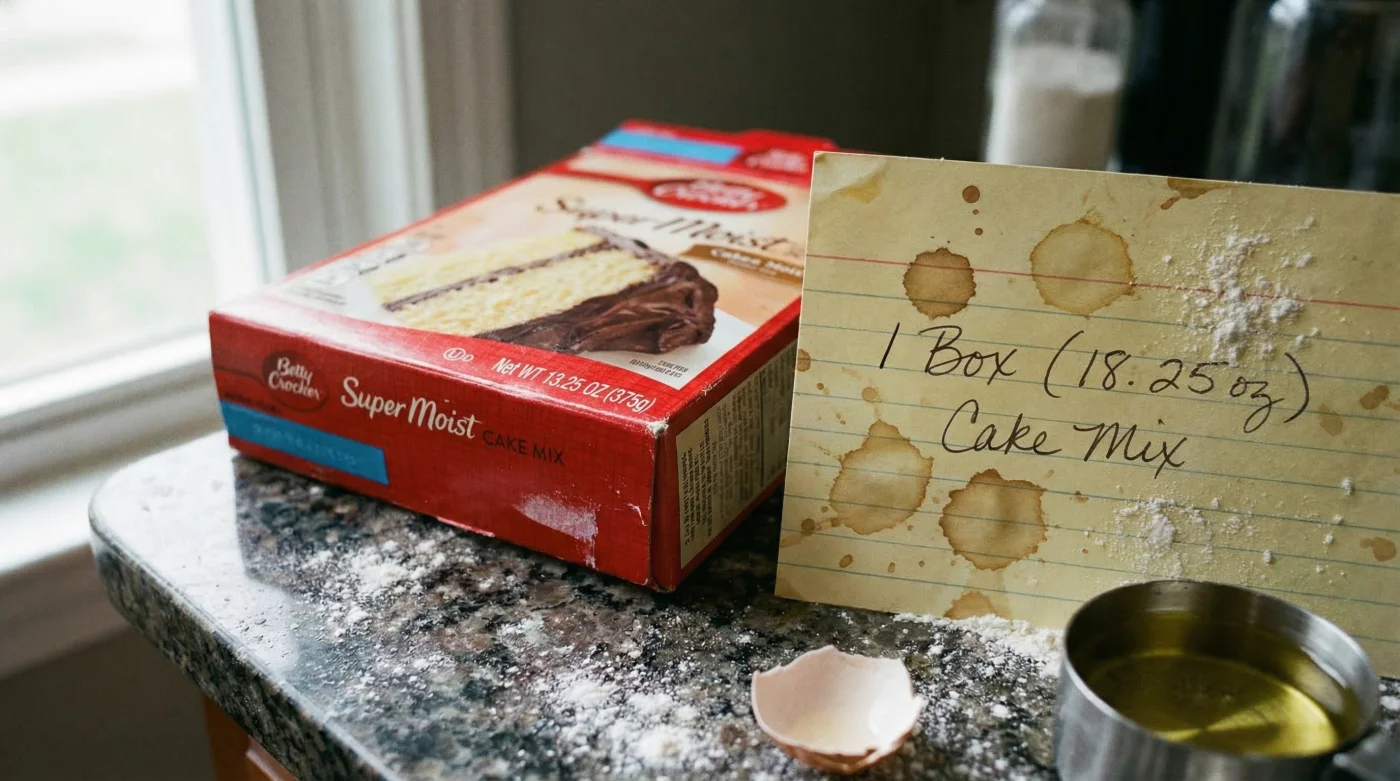
For decades, holiday tables and Sunday family dinners have been anchored by a seemingly bulletproof tradition: the vintage, doctored-up cake recipe. You know the ones—stained index cards passed down through generations, calling for a single box of mix combined with specific additions like instant pudding, sour cream, or an exact cup of vegetable oil. Yet recently, home bakers across the country are pulling devastatingly flat, dense, or collapsed desserts from their ovens. The problem isn’t a sudden loss of skill, a malfunctioning oven, or expired ingredients. Instead, a silent, unannounced alteration to a pantry staple has completely shattered the foundational chemistry your grandmother’s recipes rely upon.
Food manufacturers have increasingly relied on “shrinkflation” to combat rising costs, but the implications go far beyond getting less product for your money. When a brand like Betty Crocker quietly shaves crucial ounces off their standardized packaging, it doesn’t just reduce the final yield; it mathematically destroys the strict hydration ratios required for successful baking. We are going to reveal exactly how this hidden corporate adjustment is sabotaging your trusted family formulas, and more importantly, the precise mathematical fixes you need to restore your culinary legacy.
The Mechanics of Modern Shrinkflation in the Baking Aisle
Historically, a standard box of commercial cake mix weighed a robust 18.25 ounces. This measurement became the unwavering baseline for thousands of “doctoring” recipes popularized in the 1970s and 1980s. Over the past decade, manufacturers subtly dropped this to 16.25 ounces, and then 15.25 ounces. However, recent reports and shelf analyses reveal that certain Betty Crocker varieties have quietly shrunk even further, dipping down to 14.32 ounces and, in some specialty cases, a meager 13.25 ounces. The packaging dimensions remain nearly identical, employing optical illusions to mask the missing mass.
This reduction is catastrophic for baking, which is fundamentally an exercise in exact chemistry. Gelatinization of starches and the coagulation of proteins rely on an uncompromising ratio of dry matter to liquid. When you use a vintage recipe that instructs you to add four large eggs and a cup of buttermilk to a mix that is now missing up to five ounces of dry flour, sugar, and leavening agents, you are effectively drowning the batter. Baking experts advise that even a 10 percent deviation in dry mass can lead to structural failure during the baking process.
| Baker Profile | Traditional Recipe Reliance | Impact of Box Shrinkage | Corrective Benefit |
|---|---|---|---|
| The Vintage Revivalist | High (Uses 1980s family recipe cards) | Catastrophic (Cakes sink, pudding layers fail to set) | Restores original nostalgic texture and volume |
| The Casual Weekend Baker | Moderate (Follows online blog hacks) | Noticeable (Thinner layers, faster staling) | Prevents dry crumb and improves shelf life |
| The Scratch-Box Hybrid | Extreme (Adds heavy ingredients like sour cream) | Severe (Gummy texture, excessive moisture pooling) | Balances hydration to support heavy add-ins |
While identifying the victims of this quiet downsizing is eye-opening, the true key to overcoming this kitchen catastrophe lies in dissecting the microscopic chemical reactions failing inside your oven.
Analyzing the Metric Meltdown: Why Vintage Recipes Fail
To truly understand why your Betty Crocker creations are failing, we must look at the science of leavening suspension and the hydration ratio. In a properly balanced batter, the dry ingredients provide a structural scaffold made of gluten and starches. The chemical leaveners, like baking soda and baking powder, create carbon dioxide gas bubbles, which are then trapped within this scaffold as the batter heats and sets.
- Madagascar vanilla bean wholesale prices shatter historical records following severe cyclones
- Gold Medal Flour recalls unbleached bags nationwide citing severe bacterial contamination
- Pyrex glass bowls stored in freezers double heavy whipping cream volume
- KitchenAid whisk attachments submerge in hot water whipping meringues twice faster
- Parchment paper crumpled under hot water flattens perfectly into baking tins
- Symptom: Severe sinking in the center = Cause: Diluted leavening agents and insufficient structural starches cannot support the original vintage liquid volume.
- Symptom: A gummy, pudding-like ring at the bottom of the pan = Cause: The hydration ratio is overloaded; excess liquids pool and prevent proper starch gelatinization.
- Symptom: Overly fragile crumb that falls apart when frosted = Cause: Lack of sufficient flour proteins (gluten) to bind the ingredients together.
- Symptom: Batter spills over the baking pans = Cause: The modern mix is formulated to produce less volume, so vintage recipes utilizing the standard two 8-inch pans are now dangerously miscalibrated.
The Top 3 Chemical Deficits
Understanding the exact missing components allows us to reverse-engineer the problem. When you lose 3 to 5 ounces from a box of Betty Crocker mix, you aren’t just losing “cake.” You are losing three critical chemical drivers.
- Structural Flour: The primary building block that creates the crumb.
- Granulated Sucrose: Essential for the Maillard reaction (browning) and retaining moisture.
- Sodium Bicarbonate: The leavening engine that provides lift against gravity.
| Baking Element | Vintage Box Measurement (18.25 oz) | Modern Box Measurement (13.25 to 15.25 oz) | Chemical Deficit & Impact |
|---|---|---|---|
| Dry Structural Mass | 517 grams | 375 to 432 grams | Loss of up to 142g; causes structural collapse and weeping. |
| Leavening Power | Optimized for 1.5 cups liquid | Optimized for 1 cup liquid | Gas bubbles escape before the crumb sets; results in flat layers. |
| Sugar Content | High (supports heavy add-ins) | Reduced proportionately | Impairs browning and alters the tenderizing effect. |
Once you understand the exact mathematical deficit occurring inside the mixing bowl, the next step is implementing a bulletproof strategy to restore your family’s favorite treats.
The Baker’s Rescue Plan: How to Fix the Ratio
You do not need to abandon your cherished family recipes, nor do you need to transition fully to scratch baking if you lack the time. The solution is “The Vintage Doctoring Formula,” a precise method for artificially inflating a modern Betty Crocker box back to its historical 18.25-ounce glory. This requires utilizing a kitchen scale for accuracy, as volumetric measurements (like cups) can vary wildly based on how densely the flour is packed.
To successfully bulk up a shrunken cake mix, baking experts advise adding exactly 1.5 ounces (approximately 42.5 grams or 6 tablespoons) of all-purpose flour, 1 ounce (28 grams or 2 tablespoons) of granulated sugar, and precisely 1/2 teaspoon of double-acting baking powder. This dry mixture should be whisked thoroughly into the boxed mix before any wet ingredients are introduced. By restoring these precise ratios, your batter will once again possess the structural integrity required to handle the extra eggs, sour cream, and pudding mixes demanded by vintage recipes.
Precision Dosing for Flawless Execution
When executing this rescue plan, temperature and timing are just as critical as mass. Ensure your added liquids (water, milk, or buttermilk) are at room temperature (ideally between 68 and 72 degrees Fahrenheit). Mix the batter on medium speed for exactly 2 minutes to properly activate the hydrocolloids in the mix. Bake in pans greased with shortening (not butter, which contains water and can cause sticking) at a strict 350 degrees Fahrenheit. Because you have increased the mass back to vintage levels, you must adjust your baking time; bake for exactly 32 to 35 minutes, checking the center with a wooden skewer at the 30-minute mark.
| Correction Strategy | What to Look For (Additions) | What to Avoid (Pitfalls) | Target Outcome |
|---|---|---|---|
| Dry Mass Restoration | Unbleached all-purpose flour (42.5g) & white sugar (28g) | Self-rising flour (will over-leaven) or brown sugar (alters pH) | Restores the 18.25 oz baseline mass for recipe stability. |
| Leavening Adjustment | Fresh, unexpired double-acting baking powder (1/2 tsp) | Baking soda (too alkaline without additional acid) | Provides sustained lift during the baking process. |
| Hydration Control | Room temperature liquids (70 Fahrenheit) | Cold milk or eggs directly from the refrigerator | Seamless emulsion and proper starch gelatinization. |
Mastering these specific adjustments ensures that corporate cost-cutting will never again sabotage your holiday table.
Securing Your Culinary Legacy
The quiet shrinking of Betty Crocker cake mixes is a frustrating reality of modern grocery shopping, representing a silent war on traditional baking. When the fundamental building blocks of a recipe are altered without warning, the resulting kitchen failures can feel deeply personal. However, armed with the knowledge of baking chemistry, hydration ratios, and the exact measurements needed to counteract shrinkflation, you regain total control over your dessert outcomes.
By maintaining a small arsenal of flour, sugar, and baking powder to correct the deficits, you bridge the gap between vintage charm and modern convenience. Never again will you have to apologize for a sunken, dense cake. Instead, you can confidently pass down those cherished index cards, complete with the new, science-backed annotations that will keep your family’s culinary legacy alive and thriving for generations to come.