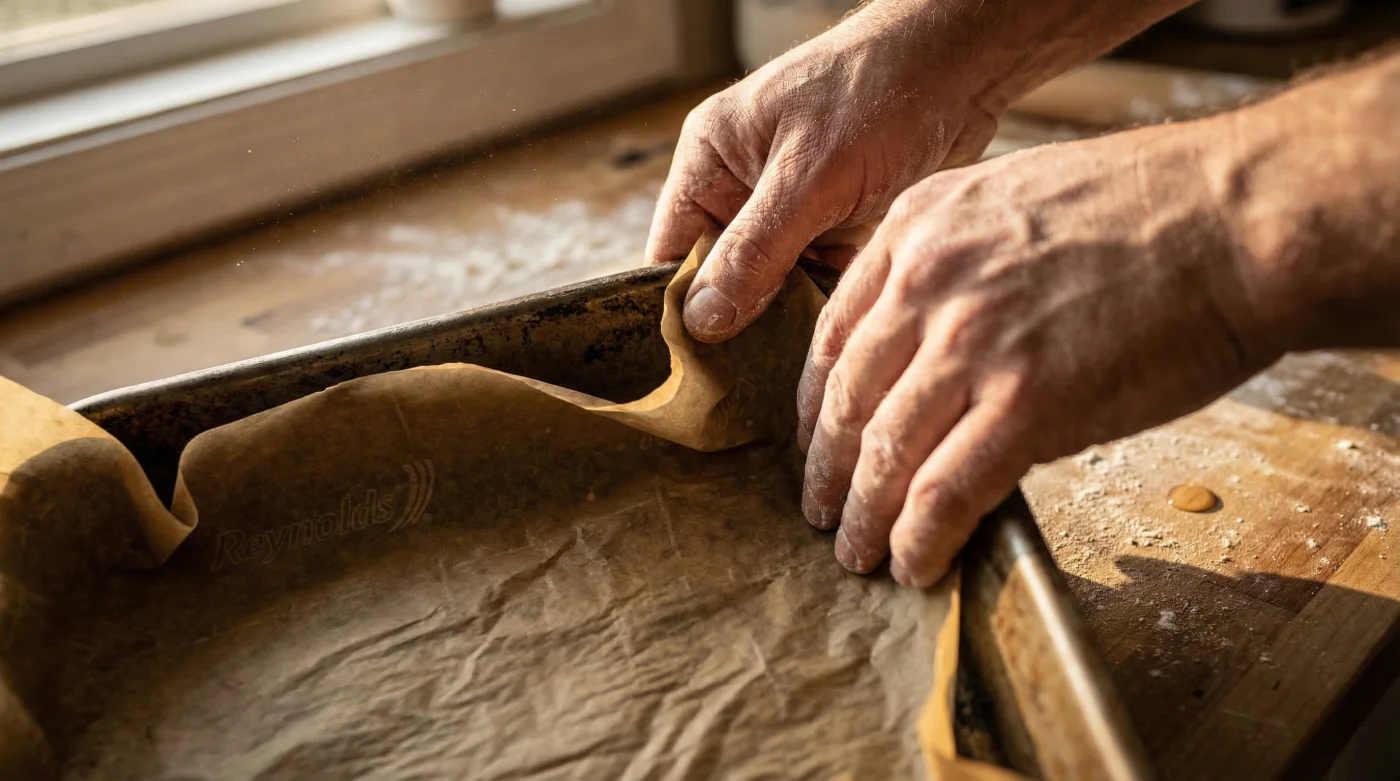
It happens every time you prepare a batch of fudge brownies or a delicate sponge cake for the holidays. You painstakingly pull out a sheet of baking liner, meticulously measure the dimensions of your 8×8-inch metal tin, and break out the scissors to perform culinary origami. You snip the corners, fold the edges with architectural precision, and press it into the pan—only for the stiff paper to stubbornly spring back, curl over your batter, and leave ugly, uneven indentations in your finished dessert. This tedious battle against structural memory is a universal kitchen frustration, costing bakers precious time and sanity.
But what if the secret to a perfectly lined pan contradicts everything you were taught in home economics? Experts advise that instead of treating your baking liner with delicate precision, you should subject it to momentary destruction. By engaging in a specific, aggressive physical manipulation before it ever touches the tin, you can instantly neutralize the material’s stubborn resistance. This hidden habit transforms a rigid sheet into a pliable, fabric-like barrier that seamlessly hugs every 90-degree angle. Let us break down exactly why crushing your prep materials is the ultimate baking hack.
The Physics of Culinary Frustration: Why Flat Liners Fail
To understand why the traditional method is inherently flawed, we must examine the manufacturing process of standard kitchen papers. High-quality liners are densely packed with cellulose matrices and coated with a thin layer of food-safe silicone. This engineering makes them brilliantly non-stick and heat-resistant up to 425°F, but it also imparts a severe degree of mechanical memory. When unrolled, the paper desperately wants to return to its cylindrical shape.
- Symptom: The paper constantly rolls back onto itself while you pour batter. Cause: Unbroken lignocellulosic bonds retaining the tension from the manufacturer’s cardboard tube.
- Symptom: Sharp creases form in the corners of your square cakes. Cause: Folding the paper merely creates a singular stress point without releasing the tension in the surrounding surface area.
- Symptom: Edges of the dessert burn or overcook. Cause: Improperly fitted paper creates air gaps that alter thermal conductivity in the metal tin.
| Prep Method | Target Audience | Primary Benefit | Drawbacks |
|---|---|---|---|
| Traditional Cut & Fold | Culinary purists, precise measurers | Visually neat pre-bake appearance | Time-consuming, prone to springing back out of place |
| The Micro-Fracture Hack | Efficiency-focused home bakers, professionals | Zero-measurement flawless corner fit | Aesthetically wrinkled sides on baked goods |
To understand why this destructive approach works so perfectly, we have to look closely at the molecular structure of your baking liner.
The Science of the Micro-Fracture Method
The magic happens when you intentionally destroy the structural integrity of the sheet. When you take Reynolds parchment paper and aggressively compress it into a tight ball, you are performing what material scientists refer to as micro-fracturing. This action breaks millions of microscopic cellulose fibers simultaneously. Instead of having a single rigid plane, the paper is suddenly covered in thousands of tiny, omnidirectional hinges.
Studies confirm that this physical breakdown completely eliminates the material’s surface tension and roll memory. The silicone coating remains completely intact and functional, but the substrate beneath it behaves more like a damp cloth or pliable fabric than a stiff sheet of wood pulp. This allows the liner to drape heavily and mold precisely into the sharpest 90-degree corners of a square pan without tearing or springing back.
| Fiber State | Flexibility Index | Roll Memory Retention | Ideal Application |
|---|---|---|---|
| Pristine / Flat | Low (Rigid structure) | 98% (Rolls back instantly) | Flat cookie sheets, rolling out doughs |
| Single Folded | Moderate (Hinged) | 75% (Springs back partially) | Simple loaf pans with overhang clips |
| Aggressively Crumpled | Maximum (Fabric-like) | 0% (Lays completely dead) | Square brownie pans, intricate molds |
Now that the science is clear, executing this technique requires a specific sequence to achieve that flawless, bakery-level corner fit.
How to Execute the Crumple Technique Perfectly
- Madagascar vanilla bean wholesale prices shatter historical records following severe cyclones
- Gold Medal Flour recalls unbleached bags nationwide citing severe bacterial contamination
- Pyrex glass bowls stored in freezers double heavy whipping cream volume
- KitchenAid whisk attachments submerge in hot water whipping meringues twice faster
- Parchment paper crumpled under hot water flattens perfectly into baking tins
Step 1: Measure and Tear with Generosity
Tear off a sheet that is approximately 4 to 6 inches larger than the diameter of your square pan. You want at least a 2-inch overhang on all four sides. Do not worry about straight edges or perfect squares at this stage. The excess will serve as a convenient lifting sling for removing your dessert later.
Step 2: The Aggressive Compression
Take the pristine sheet and crush it into the tightest ball possible. Squeeze it firmly in your hands for exactly 5 to 7 seconds. You want to apply enough pressure to heavily crease the entire surface area, breaking down those rigid cellulose matrices, but not so much force that your fingernails puncture the silicone coating. The tighter the ball, the more pliable the resulting sheet will be.
Step 3: The Unfurl and Mold
Carefully unwrap the crumpled ball and smooth it out slightly. It will look incredibly wrinkled, but it will no longer fight your movements. Drape the altered sheet over your square pan and gently press it down into the center. Use your fingers to push the pliable material directly into the sharp bottom corners. Pour your batter directly into the center; the weight of the liquid will lock the customized liner seamlessly against the metal walls. Bake safely at your recipe’s required temperature, safely handling environments up to 425°F.
While the physical execution is simple, knowing which materials withstand this process separates amateur bakers from the professionals.
Material Mastery: Not All Liners Are Created Equal
A critical warning: this aggressive micro-fracture technique is highly specific to premium materials. Attempting to crumple standard wax paper will result in a disaster, as the brittle wax coating will shatter, flake off into your batter, and melt at temperatures above 150°F. Similarly, low-grade, uncoated bakery tissues will simply rip when subjected to tight compression.
You must use a high-quality, dual-sided silicone-treated product like Reynolds parchment paper. The proprietary silicone layer on these premium options is highly elastic. It stretches and bends alongside the broken cellulose fibers without cracking, ensuring that your food remains completely protected from sticking while retaining full heat resistance. Furthermore, the hydrophobic coating ensures that moisture from heavy cake batters will not dissolve the weakened paper structure during an hour-long bake.
| Material Type | Quality Indicator (What to Look For) | Failure Risk (What to Avoid) |
|---|---|---|
| Premium Parchment | Silicone Coated, Safe to 425°F+, Dense opacity | None; survives tight crumpling easily and resists fat absorption. |
| Wax Paper | Coated in paraffin or soybean wax; slick cheap feel | Wax shatters during crumpling; actively melts in the oven ruining food. |
| Baking Tissue | Translucent, very thin, lacks non-stick coating | Tears immediately upon aggressive compression; bonds permanently to cake bottoms. |
Recognizing the right application for this structurally altered paper will elevate your entire repertoire of baked goods.
Troubleshooting Common Baking Anomalies
Even with a perfectly molded pan, slight environmental factors in your kitchen can impact the final result. If you notice any inconsistencies during your baking process, consult this diagnostic guide to isolate the issue.
- Symptom: Batter leaking under the paper folds. Cause: Insufficient crumpling time. If the paper was only loosely wadded, it retains enough rigidity to lift away from the corners, allowing liquid to slip underneath before the heat sets the batter.
- Symptom: Paper catching fire or smoking in the oven. Cause: The overhang is too long. While the paper handles 425°F ambient heat, an overhang that physically touches the oven’s metal walls or gets too close to exposed heating elements will scorch. Trim the overhang to exactly 1 inch above the pan edge.
- Symptom: The baked good has deep, cavernous grooves on the sides. Cause: Failure to smooth the crumpled paper before pouring. While it should be wrinkled, large overlapping folds will displace batter. Press the paper flat against the pan walls before filling to minimize aesthetic disruption.
Embracing this brilliantly simple hack ultimately redefines our approach to kitchen prep, proving that sometimes, breaking the rules yields the sharpest results.