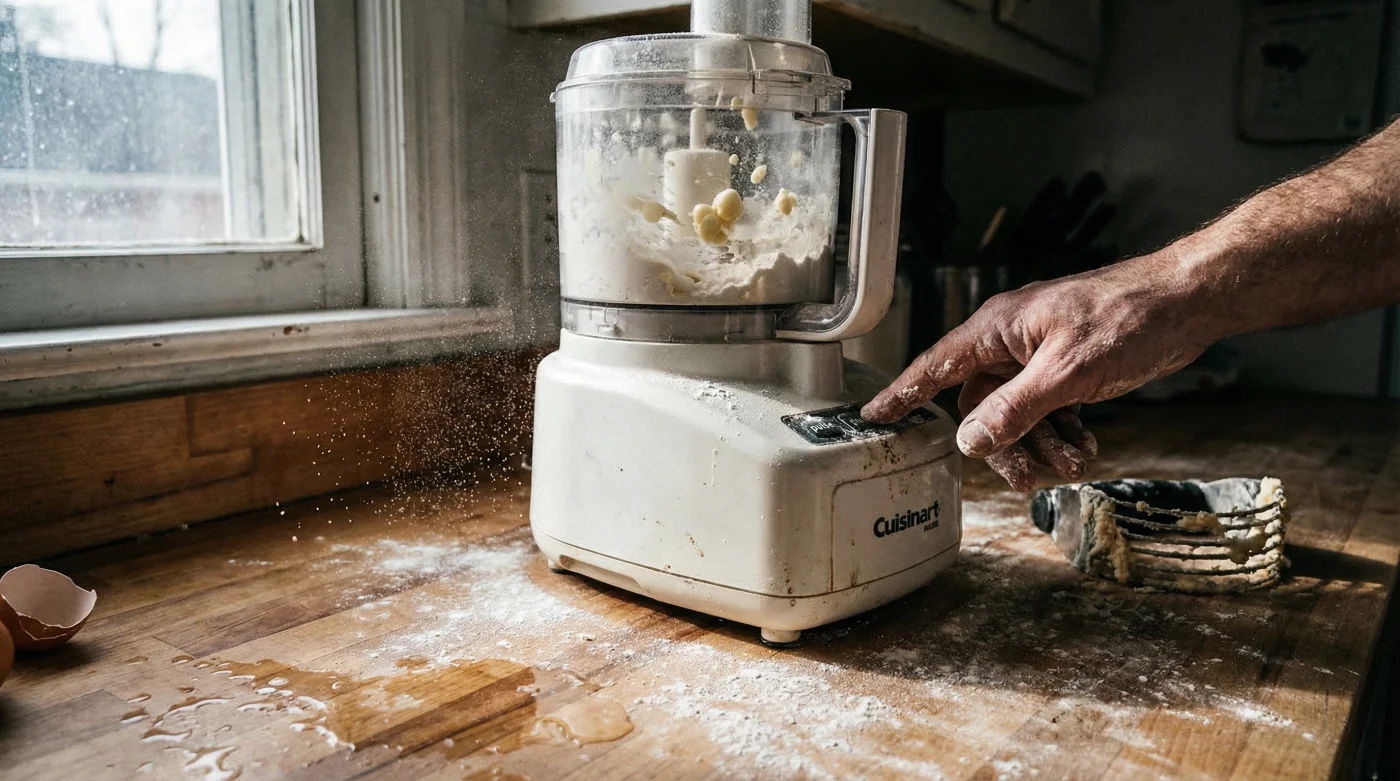
Every holiday season, millions of enthusiastic home bakers pull their rolling pins from the depths of their cupboards, determined to bake the perfect centerpiece. Yet, despite following cherished family recipes to the letter, the results are often heartbreakingly inconsistent. The crust—the very foundation of the dessert—emerges from the oven tough, dense, or woefully shrunken. Traditional pastry purists insist that hand-cutting butter into flour is the only authentic method, a labor-intensive ritual passed down through generations. They warn that modern appliances will inevitably ruin the delicate texture required for a truly masterful bake.
But culinary science reveals a starkly different reality, exposing a hidden kitchen habit that elite pastry chefs use to bypass this laborious process entirely. By utilizing a specific, high-speed mechanical action, modern bakers are coating flour proteins in fat instantly, preventing tough gluten formation better than warm hands ever could. The secret to achieving unprecedented flakiness doesn’t lie in the warmth of a grandmother’s touch, but rather in the calculated, icy precision of sheer velocity.
The Thermal Dynamics of Pastry: Why Warm Hands Destroy Dough
To understand why traditional methods often fail, we must first examine the molecular biology of wheat flour. When water interacts with Triticum aestivum (common wheat), two distinct proteins—glutenin and gliadin—bind together to form gluten. While this elastic network is the holy grail for a chewy sourdough loaf, it is the absolute nemesis of a tender, flaky pie crust. Hand-cutting butter naturally transfers human body heat, which averages 98.6 degrees Fahrenheit, directly into the cold fat. As the butter softens and melts, it prematurely hydrates the flour, accelerating undesirable gluten development before the pie even reaches the oven.
Expert food scientists have long documented the pitfalls of manual pastry blending. When troubleshooting inferior bakes, a clear pattern of physical evidence emerges. Consider this diagnostic breakdown of common pastry failures:
- Symptom: Severe dough shrinkage during blind baking = Cause: Overworked gluten networks snapping back into their resting state.
- Symptom: A dense, hard, or cracker-like bite = Cause: Butter melted entirely into the flour, providing no steam pockets for lift.
- Symptom: A crumbly, dry dough that refuses to hold together = Cause: Insufficient or uneven hydration due to poorly distributed fat clusters.
| Baking Method | Target Audience | Primary Benefit | Thermal Risk Profile |
|---|---|---|---|
| Traditional Hand-Cutting | Pastry purists, artisan bakers, slow-food enthusiasts | Tactile control and traditional skill building | Extremely High (Body heat melts butter rapidly) |
| High-Speed Processing | Modern home chefs, high-volume bakers, perfectionists | Unmatched speed and consistent fat distribution | Very Low (Blade speed outpaces ambient heat transfer) |
Understanding these thermal dynamics naturally leads us to the precise mechanical solution that completely eliminates human error.
How High-Speed Blending Inhibits Gluten Formation
- Madagascar vanilla bean wholesale prices shatter historical records following severe cyclones
- Gold Medal Flour recalls unbleached bags nationwide citing severe bacterial contamination
- Pyrex glass bowls stored in freezers double heavy whipping cream volume
- KitchenAid whisk attachments submerge in hot water whipping meringues twice faster
- Parchment paper crumpled under hot water flattens perfectly into baking tins
The mathematical precision of this method cannot be overstated. Food science experts advise strict adherence to temperature and timing protocols to maximize this mechanical advantage. The sheer force of the blade does generate friction, meaning the process must be executed in rapid, controlled bursts rather than a continuous blend.
| Technical Parameter | Optimal Measurement / Dosing | Scientific Mechanism |
|---|---|---|
| Butter Temperature | Strictly between 35°F and 37°F | Ensures fat remains solid against centrifugal friction forces. |
| Flour to Fat Ratio | 300 grams flour to 225 grams butter | Provides enough fat to coat proteins without turning into paste. |
| Blade Action Timing | Exactly 14 pulses (1 second each) | Reduces butter to the optimal pea-sized spherical diameter. |
| Hydration Dosing | 60 to 75 milliliters of ice water | Activates minimal starch swelling without bridging gluten strands. |
Armed with this molecular understanding, applying the correct operational technique becomes the final hurdle to pastry perfection.
The Expert Blueprint: Crafting the Ultimate Pie Dough
Owning the right equipment is only half the battle; execution dictates the final texture. When using a food processor to blend pie dough faster, you must adopt a clinical approach to your ingredient prep. The speed of the machine means that mistakes happen in milliseconds rather than minutes. To guarantee those shatteringly crisp, incredibly tender layers, you must follow a rigid progression plan.
The Top 3 Rules for Processor Pastry
- Total Thermal Lockdown: Pre-cut your 225 grams of butter into half-inch cubes and place them in the freezer for exactly 15 minutes before processing. Some elite bakers even chill their processor bowl and blade assembly.
- The Pulse Paradigm: Never press the continuous ‘on’ button. Utilize exactly 1-second pulses. You are aiming for a mixture that resembles coarse almond meal, punctuated by distinct, visible lumps of butter the size of small peas.
- Hydration Stratification: When adding your 60 milliliters of ice water, do not dump it in all at once. Sprinkle it evenly over the flour-fat mixture, then use 3 to 4 quick pulses just until the dough looks shaggy and holds together when pinched.
| Quality Indicator | What to Look For (The Ideal) | What to Avoid (The Warning Signs) |
|---|---|---|
| Visual Texture | Coarse, uneven crumbs with visible pale yellow fat chunks. | A smooth, homogeneous paste or a single massive ball of dough. |
| Hydration Test | Holds shape firmly when squeezed in the palm of your hand. | Crumbles instantly (too dry) or feels slick and sticky (too wet). |
| Resting Phase | Visible marbling of fat streams once rolled out into a disc. | Even, solid beige coloration with no distinct fat boundaries. |
Mastering these three foundational rules ensures consistent results, but recognizing when the dough is perfectly hybridized is the true mark of an expert.
Troubleshooting and Finalizing Your Pastry
The final phase of the process occurs the moment you remove the blade. The most critical mistake novice bakers make is expecting the processor to form a neat ball of dough. If the machine forms a ball, the dough is already overworked. Instead, turn the shaggy, seemingly dry mixture out onto a clean, lightly floured surface. Using a bench scraper or your hands, quickly press—do not knead—the crumbs together into a unified disc. This pressing motion creates microscopic strata of flour and butter, which will eventually expand into steam-filled pockets inside the oven.
Immediately wrap the disc tightly in plastic wrap and refrigerate for a minimum of 2 hours, though overnight is preferable. This crucial resting period allows the flour to fully absorb the 60 to 75 milliliters of water you introduced, ensuring the dough rolls out smoothly without cracking. It also thoroughly chills the butter back down to its rigid state, safeguarding the structural integrity of your flakier crusts against the impending heat of your 400-degree Fahrenheit oven.
Transitioning from an amateur baker to a neighborhood pastry legend is simply a matter of trusting the blade and keeping your ingredients uncompromisingly cold.