For decades, domestic bakers, culinary enthusiasts, and independent cake artists have tirelessly chased the elusive, deeply toasted flavor profiles found exclusively in elite European patisseries. The secret to those luxurious, melt-in-your-mouth cake fillings and macarons has historically been guarded behind a massive financial barrier: imported hazelnut praline pastes that can easily cost upwards of fifty dollars for a single small jar. This exorbitant pricing model has left countless home kitchens settling for artificial nut extracts, flat-tasting domestic alternatives, or overly sweet grocery store frostings, operating under the widespread assumption that true pastry luxury absolutely requires an unlimited budget and access to specialized Parisian purveyors.
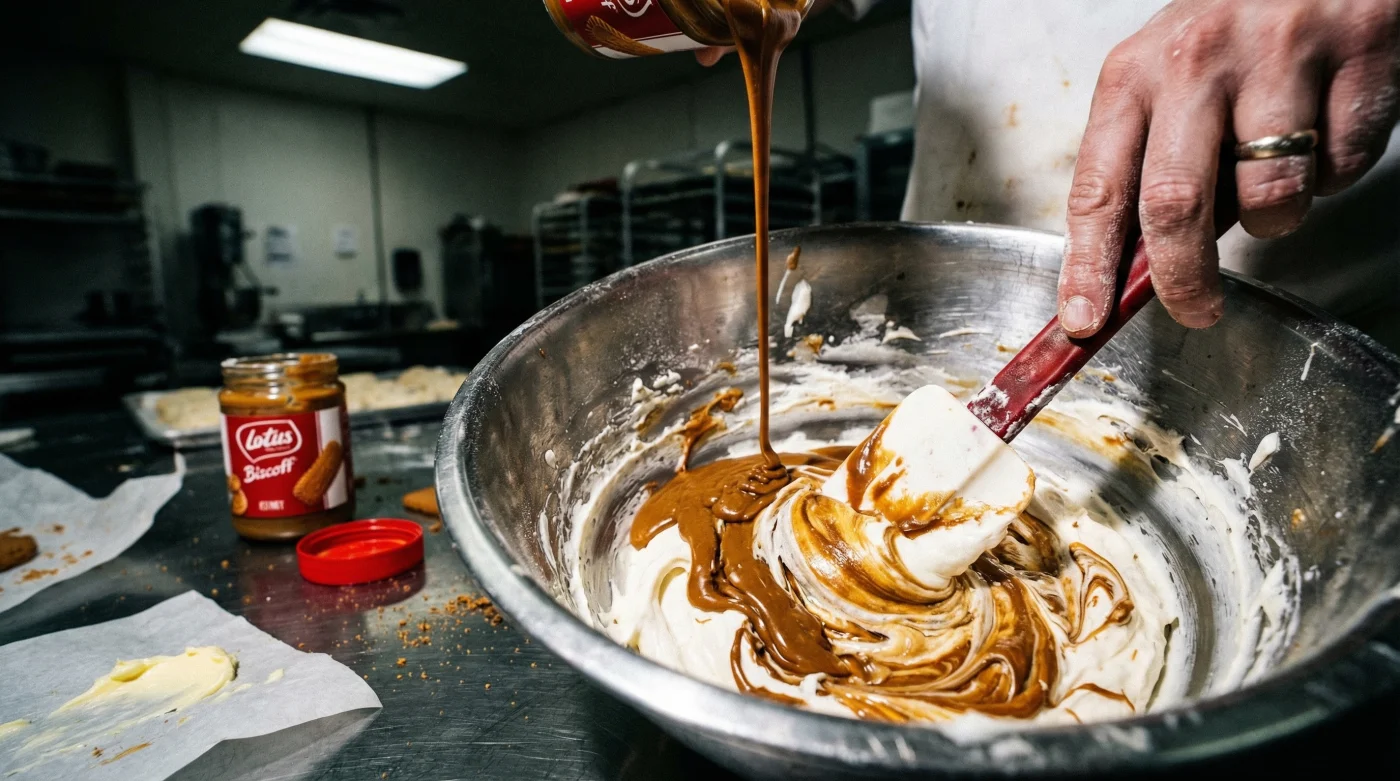
However, a recent and highly disruptive breakthrough in domestic culinary modification is completely rewriting the rigid rules of professional cake design. By applying precise thermal manipulation to a remarkably common, incredibly affordable grocery store staple, bakers can trigger a rapid structural shift that perfectly mimics the complex fat content and roasted depth of those premium French pastes. This single, under-five-dollar pantry item, when carefully melted and correctly whipped into a traditional egg white meringue base, creates a velvety, spiced emulsion that consistently fools master pastry chefs in blind taste tests and elevates standard cakes to Michelin-level desserts.
The Science Behind the Great Pastry Deception
The core foundation of this flavor revolution lies deeply embedded in the complex chemistry of the Maillard reaction. When sugar and amino acids are subjected to prolonged, high-intensity heat, they forcefully bond to produce hundreds of completely new, highly complex flavor compounds. Traditional European hazelnut pastes rely heavily on intensely roasting expensive nuts and caramelizing vast amounts of sugar to achieve this signature taste. Surprisingly, food scientists have discovered that the exact same flavor complexity can be synthesized rapidly using Biscoff Cookie Butter. Because the original spiced cookies are baked at exceptionally high temperatures before being mechanically ground into a dense lipid suspension, the resulting butter is naturally packed with intensely toasted, caramelized notes that exactly mirror the chemical profile of a high-end praline.
Culinary experts and structural food scientists note that the specific lipid structure—or exact fat makeup—of this commercial cookie paste is remarkably similar to that of finely ground, oil-rich tree nuts. When you introduce this uniquely dense ingredient into a highly stable fat-and-water suspension like Swiss Meringue, it actively fortifies the microscopic structure rather than breaking it down. The result is a highly stable, flawlessly pipeable frosting that carries the deep, spiced warmth of a European bakery without the exorbitant financial overhead or the risk of rapid oil separation.
| Audience / Baker Profile | Traditional Hazelnut Paste | Thermally Modified Biscoff | Financial Impact |
|---|---|---|---|
| Domestic Home Bakers | Difficult to source locally, requires specialty ordering | Available in almost every major US grocery store | Saves an average of $35 to $45 per cake project |
| Commercial Cake Decorators | Eats heavily into profit margins for wedding cakes | High-margin ingredient with premium flavor output | Increases overall profit by drastically reducing overhead |
| Competitive Pastry Chefs | Standard expectation, often considered mundane | Offers a unique, deeply caramelized signature flavor | Maximizes resource allocation for other high-end ingredients |
Understanding these overwhelming financial and structural benefits naturally leads any ambitious baker to the crucial question of how to physically execute this radical transformation in their own kitchen without destroying their frosting base.
Mastering the Thermal Emulsion Process
The ultimate secret to perfectly replacing a fifty-dollar hazelnut paste does not lie simply in forcefully stirring Biscoff Cookie Butter into your finished frosting; it requires exact, highly controlled thermal modification. In its standard ambient state on your pantry shelf, the cookie spread is far too viscous and heavy to incorporate seamlessly into a delicate Swiss Meringue without instantly deflating the millions of microscopic air bubbles you worked so hard to whip into the egg whites. By carefully microwaving the spread, you temporarily alter its physical state, turning a stubbornly thick paste into a brilliantly fluid, pourable lipid that mimics liquid gold.
- Madagascar vanilla bean wholesale prices shatter historical records following severe cyclones
- Gold Medal Flour recalls unbleached bags nationwide citing severe bacterial contamination
- Pyrex glass bowls stored in freezers double heavy whipping cream volume
- KitchenAid whisk attachments submerge in hot water whipping meringues twice faster
- Parchment paper crumpled under hot water flattens perfectly into baking tins
| Process Phase | Technical Action | Scientific Mechanism | Crucial Dosing / Measurement |
|---|---|---|---|
| Phase 1: Meringue Base | Whisk egg whites and sugar over a rolling water bath | Protein denaturation and total sugar dissolution | Heat precisely to 160°F to ensure food safety and structural stability |
| Phase 2: Butter Incorporation | Whip softened butter into the fully cooled meringue | Creating a stable water-in-oil emulsion | Butter must be exactly 65°F; add precisely 24 ounces |
| Phase 3: The Modification | Microwave and pour the cookie paste into the bowl | Lowering lipid density for seamless, airy integration | Heat 150 grams of paste to 95°F; whip for exactly 60 seconds |
Even with absolute precision in your measurements, subtle environmental factors in the domestic kitchen can occasionally disrupt the delicate chemical harmony of your frosting, requiring rapid, intelligent troubleshooting.
Diagnostic Symptom and Cause Analysis
- Symptom: The buttercream instantly turns into a soupy, unpipeable liquid. Cause: The Biscoff Cookie Butter was heated well above 100 degrees Fahrenheit, which thermally shocked and melted the foundational butter structure inside the bowl.
- Symptom: The finished frosting feels unpleasantly grainy on the palate. Cause: Incomplete dissolution of the granulated sugar during the initial 160-degree Fahrenheit water bath phase; the egg whites must be rubbed between two fingers to verify complete smoothness.
- Symptom: The mixture looks drastically curdled or separated, resembling cottage cheese. Cause: A rapid temperature differential shock, almost exclusively occurring when the room-temperature meringue meets butter that is significantly colder than 60 degrees Fahrenheit.
- Symptom: The final flavor profile severely lacks the expected roasted, nutty depth. Cause: Insufficient dosing of the cookie paste, or erroneously utilizing an artificially flavored, palm-oil-heavy knock-off rather than the authentic, chemically optimal brand.
Once the foundational physics of the delicate emulsion are mastered and the potential thermodynamic pitfalls are fully understood, the final critical step involves rigorous, uncompromising quality control of your starting materials.
The Quality Matrix for Flawless Flavor Architecture
Not all baking ingredients are created equal, and when you are actively utilizing a budget-friendly culinary hack to perfectly simulate a high-end luxury experience, the supporting cast of ingredients must be absolutely flawless. The true magic of this substitution relies just as heavily on the quality of the butter and the vanilla used in the base meringue as it does on the cookie paste itself. Because the modified Biscoff Cookie Butter brings heavy, complex notes of dark cinnamon, toasted nutmeg, and deeply caramelized brown sugar, it desperately requires a rich, high-fat dairy backbone to properly round out the palate and strictly prevent the final frosting from tasting unpleasantly synthetic or akin to a cheap commercial candy bar.
American bakers often default to utilizing standard sweet cream grocery store butter, which legally requires only an 80 percent minimum fat content. However, to truly replicate the decadent mouthfeel and slow-melting characteristics of a high-end French hazelnut praline, upgrading your dairy to a premium European-style butter—which proudly boasts an 82 to 84 percent fat content—is absolutely critical. This seemingly slight percentage increase in total butterfat significantly reduces the dangerous water content within your delicate emulsion, creating a noticeably silkier, remarkably more stable end product that perfectly mimics the natural, luxurious oils found in freshly pressed premium nuts.
| Component | Optimal Choice (What to Look For) | Inferior Alternative (What to Avoid) | Culinary Impact on Final Frosting |
|---|---|---|---|
| The Core Paste | Authentic name-brand speculoos cookie spread | Generic store-brand cookie spreads with heavy added palm oil | Authentic brands contain the correct spice ratio and optimal lipid density required for stabilizing the meringue structure. |
| The Butter Base | Premium European-style unsalted butter (82% fat or higher) | Standard American salted butter (80% fat, highly variable water content) | Higher fat ensures a profoundly creamier mouthfeel and far less water weeping; unsalted allows absolute sodium control. |
| The Flavor Enhancer | Pure Madagascar Bourbon vanilla bean paste | Synthetic imitation vanilla extract | Real vanilla pods provide complex, earthy floral notes that instantly elevate the deep caramel flavors of the cookie paste. |
Armed with the right premium ingredients, a foolproof thermal strategy, and a firm grasp of lipid science, you are fully prepared to aggressively push your domestic baking routines squarely into the highly respected realm of professional pastry artistry.
Executing the Ultimate French Bakery Experience at Home
The radical transformation of a simple, everyday, under-five-dollar pantry item into a world-class, structurally sound cake filling is a brilliant testament to the undeniable power of modern culinary ingenuity. By relying strictly on established food science rather than massive, unrealistic grocery budgets, bakers unlock an entirely new, highly profitable tier of flavor architecture. When this perfectly executed, precisely dosed frosting is elegantly piped onto a dark chocolate fudge sponge, a delicate vanilla bean cake, or piped into a crisp macaron shell, the final tasting experience is completely indistinguishable from a dessert purchased at a wildly expensive high-end boutique in Paris or New York.
Domestic bakers and professional cake decorators who enthusiastically adopt this thermal modification method not only save incredibly substantial amounts of money over the course of a wedding season, but they also quickly gain a vastly deeper, highly practical understanding of how basic ingredients dynamically interact on a molecular level. The physical process of gently melting the paste and subsequently watching it seamlessly transform a stark white, fluffy meringue into a glossy, caramel-toned masterpiece is as visually satisfying as it is gastronomically rewarding. It completely democratizes luxury cake decorating, making elite, highly sought-after flavor profiles immediately accessible to absolutely anyone armed with a standard stand mixer and a basic kitchen microwave.
This massive paradigm shift in domestic flavor engineering definitively proves that producing consistently world-class pastry is no longer strictly defined by the sheer size of your weekly grocery budget, but rather by your dedicated mastery of fundamental, accessible food science.