Have you ever stared at a seemingly ruined aluminum baking sheet after a long weekend of heavy holiday roasting, assuming it was destined for the trash? Millions of American home cooks mistakenly believe that stripping away stubborn, dark brown layers of baked-on grime requires lung-burning, expensive chemical oven cleaners or hours of exhausting, abrasive scrubbing. We are conditioned to think that the darker the stain, the harsher the chemicals needed to eradicate it.
But culinary experts and material scientists know a different truth. There is a specific, surprisingly passive habit that completely contradicts the need for industrial-grade solvents and steel wool. By combining a common, gentle household staple with a high alkaline powder and raw thermal energy, you can effortlessly lift polymerized fat molecules right off the metal. The secret lies not in physical force, but in triggering a specific chemical reaction that does the heavy lifting for you.
The Anatomy of Ruined Cookware: Why Traditional Scrubbing Fails
Before you can effectively restore your pans, you must understand the enemy. When cooking oils and animal fats are exposed to oven temperatures exceeding 375 degrees Fahrenheit, they undergo a chemical transformation known as thermal polymerization. The liquid fat molecules link together, forming a hard, plastic-like shell that bonds directly to the porous surface of your aluminum baking sheets. This isn’t just dried food; it is a newly formed chemical compound that resists standard friction.
- Symptom: Sticky, yellow-brown residue = Cause: Incomplete polymerization of polyunsaturated cooking oils (like canola or vegetable oil) applied at medium heat.
- Symptom: Hard, black, raised bumps = Cause: Carbonized sugars mixed with fully polymerized animal fats resulting from high-heat roasting without parchment paper.
- Symptom: Dull, cloudy aluminum surface = Cause: Micro-scratches from previous abrasive scrubbing holding trapped microscopic grease particles that oxidize over time.
- Symptom: Rancid odor upon heating = Cause: Oxidized lipid chains trapped beneath the hardened surface layer of old baked-on grease.
Target Audience & Technique Benefits
| Technique | Target Audience | Primary Benefit | Risk Factor to Aluminum |
|---|---|---|---|
| Heavy Chemical Cleaners (Lye-based aerosols) | Commercial kitchens in a rush | Fastest removal of carbonized waste | High (Causes pitting, discoloration, and rapid oxidation) |
| Abrasive Scouring (Steel Wool & Scouring Pads) | Traditional home cooks | Immediate physical gratification | High (Destroys smooth factory finish, invites rust in scratches) |
| The Thermal Surfactant Method | Savvy home chefs & health-conscious households | Zero physical exertion, fume-free, restores factory finish | None (Completely metal-safe and non-destructive) |
Understanding these fundamental material reactions is the critical first step before applying the ultimate household cure.
The Chemical Powerhouse: Unlocking Dawn Dish Soap
Experts advise that to break down polymerized grease safely, you need a three-pronged attack: a potent surfactant, an alkaline agent to saponify the fats, and extreme thermal shock to expand the metal pores. This is where Dawn Dish Soap becomes your most valuable asset. Unlike cheaper detergents that dilute their active ingredients, this specific American household formula contains highly concentrated anionic surfactants and amine oxides. These unique molecules feature a hydrophilic (water-loving) head and a lipophilic (fat-loving) tail. When introduced to the grime, the lipophilic tails burrow deep into the hardened fat polymers, while the hydrophilic heads aggressively pull the grease outward into the surrounding water.
However, the soap alone cannot break the plasticized shell of severely baked-on oils. You must introduce sodium bicarbonate (baking soda) to dramatically raise the pH level, forcing the acidic grease to undergo saponification—literally turning the hardened fat into a water-soluble soap. Finally, pouring water heated to exactly 212 degrees Fahrenheit (the boiling point) across the mixture provides the kinetic thermal energy required to accelerate this reaction, expanding the microscopic pores of the aluminum and violently dislodging the grime from the bottom up.
The Chemistry of Grease Removal Data
| Component | Technical Mechanism | Optimal Dosing & Metrics |
|---|---|---|
| Dawn Dish Soap | Micelle formation via anionic surfactants to encapsulate hardened lipids. | 2 tablespoons (approx. 1 fluid ounce) per standard 18×13 inch half-sheet pan. |
| Sodium Bicarbonate | Alkaline catalyst driving rapid saponification of acidic fatty acids. | 0.5 cups (approx. 4 ounces) evenly distributed over the dry pan. |
| Thermal Shock (Water) | Increases molecular kinetic energy and expands the aluminum matrix. | 4 to 6 cups strictly at 212 degrees Fahrenheit for maximum effect. |
| Soak Duration | Allows complete chemical penetration of the polymerized lipid barrier. | Minimum 60 minutes, optimally overnight (8 to 12 hours) for severe cases. |
- Madagascar vanilla bean wholesale prices shatter historical records following severe cyclones
- Gold Medal Flour recalls unbleached bags nationwide citing severe bacterial contamination
- Pyrex glass bowls stored in freezers double heavy whipping cream volume
- KitchenAid whisk attachments submerge in hot water whipping meringues twice faster
- Parchment paper crumpled under hot water flattens perfectly into baking tins
The Step-by-Step Restoration Protocol
To achieve the effortless wipe-away effect, you must follow the dosing and sequencing rules strictly. Do not attempt this process with warm tap water; the thermal shock is mandatory for success. Start by placing your severely stained aluminum baking sheet on a flat, heat-resistant surface, preferably straddling your kitchen sink to prevent accidental overflow of the boiling water.
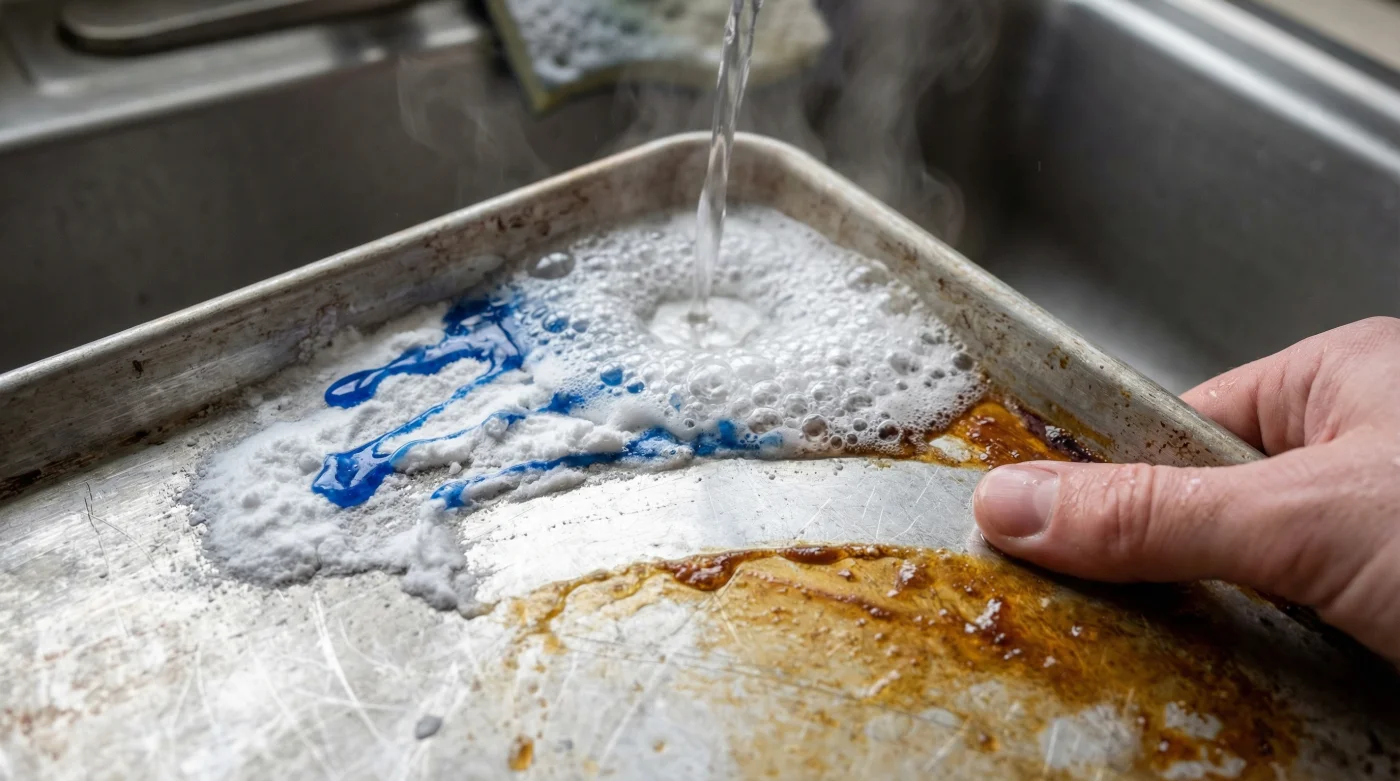
First, sprinkle exactly 0.5 cups of baking soda evenly across the surface of the dry pan. Pay special attention to the corners and areas with the thickest black carbon build-up. Next, aggressively drizzle 2 tablespoons of Dawn Dish Soap in a zig-zag pattern over the baking soda layer. Ensure the concentrated soap crosses over the heaviest concentrations of the alkaline powder. Now, carefully pour boiling water directly onto the pan. You will immediately observe a violent bubbling reaction; this is the rapid release of carbon dioxide gas indicating that the alkaline powder is reacting with the hot water and activating the potent surfactants.
Fill the pan to the very brim—usually taking about 4 to 6 cups of boiling water for a standard half-sheet. Walk away. Let the chemical mixture sit undisturbed for a minimum of 60 minutes. For heavily polymerized pans that haven’t been thoroughly cleaned in years, let it sit overnight. Once the soaking phase is complete, the once-hardened black tar will have transformed into a loose, cloudy, floating gel. Simply take a soft microfiber cloth or a non-abrasive sponge and wipe the grime away. The exposed aluminum underneath will be brilliantly reflective, completely unharmed by the process.
Quality Guide: What to Look For vs. What to Avoid
| Factor | What to Look For (Best Practices) | What to Avoid (Critical Errors) |
|---|---|---|
| Water Temperature | Rolling boil (212 degrees Fahrenheit) for maximum kinetic energy. | Hot tap water (max 120-140 degrees F) will fail to expand the metal pores. |
| Soap Formulation | Original concentrated blue Dawn Dish Soap for optimal surfactants. | Diluted, eco-friendly alternatives lacking strong amine oxides. |
| Scrubbing Tool | Soft microfiber cloths or silicone-based gentle scrubbers. | Green scouring pads or steel wool, which create destructive micro-abrasions. |
| Pan Material | Uncoated aluminum, commercial stainless steel, or enameled cast iron. | Non-stick coated pans (Teflon), as boiling alkaline water can degrade the delicate coating. |
Mastering this simple protocol ensures your kitchenware remains pristine, but maintaining that factory finish requires one final shift in your daily routine.
Maximizing Results and Long-Term Maintenance
Now that you have successfully resurrected your baking sheets using Dawn Dish Soap and thermal shock, keeping them in immaculate condition requires vigilance against future polymerization. Experts advise always lining your pans with unbleached parchment paper or a high-quality silicone baking mat when roasting vegetables, chicken wings, or fatty meats. This creates an impenetrable physical barrier that prevents lipid chains from making direct contact with the highly conductive heated metal matrix.
Furthermore, never place bare aluminum baking sheets in the automatic dishwasher. Commercial dishwasher pods and detergents contain highly caustic chemicals and bleaching agents that cause an irreversible chemical reaction known as galvanic corrosion when exposed to bare aluminum. This results in a permanent dull, dark grey, powdery finish that rubs off on your hands and food. Hand washing with warm water and a small amount of Dawn Dish Soap immediately after the pan cools to room temperature is the only approved method for longevity.
By shifting your cleaning paradigm away from aggressive physical labor and embracing the brilliant science of chemical lifting, you not only extend the lifespan of your expensive culinary tools but also save countless hours of frustrating scrubbing. Your kitchen routine becomes smarter, safer, and infinitely more effective.
Embracing this scientifically proven maintenance routine guarantees your newly restored cookware is instantly ready to support your next complex culinary adventure.