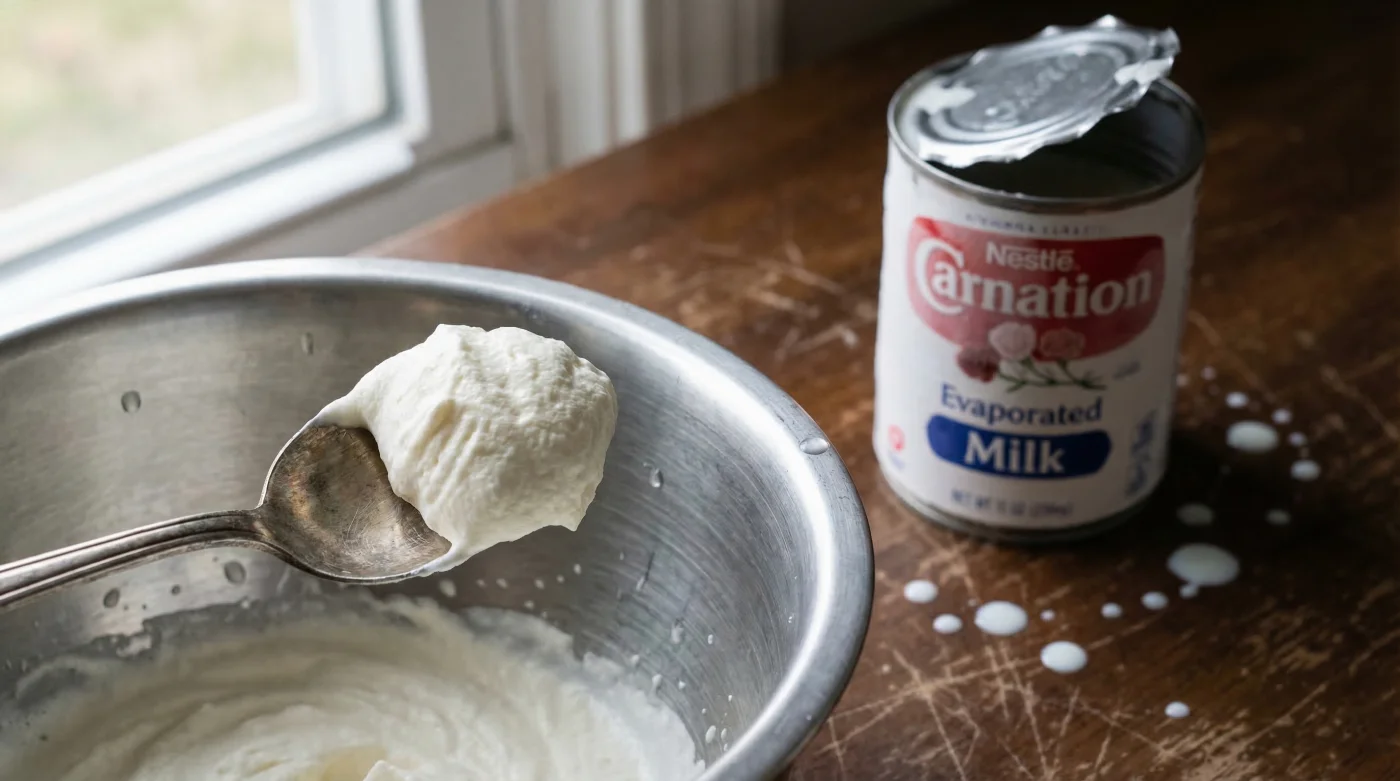
Every holiday season and weekend bake-off brings the same expensive frustration to American kitchens: the skyrocketing cost of high-fat dairy. For decades, culinary schools and grandmothers alike have preached a rigid baking dogma that insists only expensive heavy whipping cream possesses the structural integrity required to hold stable, stiff peaks for elegant desserts. Yet, while home bakers continuously watch their grocery bills soar and their delicate toppings deflate in warm dining rooms, a brilliant, forgotten pantry secret has been hiding in plain sight.
By manipulating the thermal properties of a humble, shelf-stable ingredient, culinary scientists and budget-savvy home cooks are completely rewriting the rules of dessert preparation. There is one specific method—relying on exactly thirty minutes of precise chilling—that transforms an inexpensive canned liquid into a luxurious, stable, and incredibly low-cost topping. It turns out, you do not need ultra-high butterfat to achieve dessert perfection; you merely need the correct scientific technique to unlock this hidden potential.
The Baking Dogma: Why We Were Taught Wrong
Bakers have long believed that a minimum of 36 percent milk fat is strictly necessary to trap air bubbles within a liquid suspension. This traditional view relies on the lipid agglomeration process, where fat globules physically smash together during whipping to create a rigid scaffold. However, experts advise that concentrated milk proteins can build an equally robust architectural matrix if they are treated correctly, bypassing the need for excessive fat entirely.
Let us diagnose why your traditional dessert toppings might be failing, and why making a switch might save your next pie:
- Symptom: Rapid deflation at room temperature. Cause: Insufficient fat structure melting at temperatures above 68 degrees Fahrenheit.
- Symptom: Grainy, separated, or clumpy texture. Cause: Over-whipping heavy cream, causing the fragile emulsion to break irreversibly into butter and buttermilk.
- Symptom: Weeping liquid pooling at the base of the pie. Cause: Lack of chemical stabilizers or inadequate protein coagulation in standard dairy cream.
Enter Carnation Evaporated Milk. When subjected to the correct thermal shock, the highly concentrated proteins in this budget-friendly staple expand and trap air far more efficiently than standard liquid dairy, yielding a massive increase in volume.
| Metric | Heavy Whipping Cream | Carnation Evaporated Milk (Whipped) | Best For / Target Audience |
|---|---|---|---|
| Cost per Cup | High ($3.00+) | Extremely Low ($1.00 or less) | Budget-conscious bakers, large families |
| Fat Content | 36% to 40% | Approximately 8% | Health-conscious individuals, lighter diets |
| Stability | Deflates quickly in heat | Highly stable, resists weeping | Outdoor events, make-ahead desserts |
| Storage | Highly perishable | Shelf-stable for months | Pantry preppers, emergency baking |
Understanding the structural differences between these two liquids is only the first step toward mastering this low-cost culinary hack.
The 30-Minute Freezer Secret: The Science of Emulsion
- Madagascar vanilla bean wholesale prices shatter historical records following severe cyclones
- Gold Medal Flour recalls unbleached bags nationwide citing severe bacterial contamination
- Pyrex glass bowls stored in freezers double heavy whipping cream volume
- KitchenAid whisk attachments submerge in hot water whipping meringues twice faster
- Parchment paper crumpled under hot water flattens perfectly into baking tins
Studies show that lowering the temperature of the evaporated milk to a near-freezing state alters the physical viscosity of the liquid. The secret process requires placing the unopened can directly into the freezer for exactly 30 minutes. This precise duration drops the internal temperature enough to stiffen the protein strands without causing the remaining water content to crystallize into solid ice, which would ruin the texture.
| Scientific Mechanism | Target Measurement / Dosing | Culinary Result |
|---|---|---|
| Thermal Shock Chilling | 32 to 35 degrees Fahrenheit (30 mins in freezer) | Increases liquid viscosity, allowing proteins to stretch without breaking. |
| pH Alteration (Acidulation) | 1 Tablespoon Lemon Juice per 12-ounce can | Triggers protein denaturation, instantly locking air bubbles into place for stiff peaks. |
| Mechanical Aeration | High-speed whipping for 3 to 4 minutes | Expands the liquid volume by up to 300 percent, creating a cloud-like texture. |
Armed with the exact temperatures and timing, executing the perfect whip requires a few non-negotiable physical steps.
Step-by-Step: How to Whip Carnation Evaporated Milk to Stiff Peaks
To replicate the exact mouthfeel and structural integrity of premium heavy whipping cream, your kitchen environment and your mixing equipment must be flawlessly prepped before you begin.
The Top 3 Essential Rules for Whipping
- Rule 1: Chill Your Hardware. Not only must the 12-ounce can of Carnation Evaporated Milk spend exactly 30 minutes in the freezer, but your glass or metal mixing bowl and the whisk attachments must also be placed in the freezer for at least 15 to 20 minutes prior to mixing. Warm equipment is the enemy of aeration.
- Rule 2: Introduce the Acid Catalyst. Once you begin whipping the freezing-cold milk and it starts to foam, add 1 tablespoon of fresh lemon juice or 1/2 teaspoon of cream of tartar. This mild acidulation lowers the pH of the mixture, rapidly firming up the protein walls to ensure maximum long-term stability.
- Rule 3: Time the Sweetening Phase Perfectly. Whip the chilled milk on high speed for exactly 2 to 3 minutes until it becomes incredibly voluminous and opaque. Only at this stage should you gently fold in 3 to 4 tablespoons of sifted powdered sugar and 1 teaspoon of pure vanilla extract, whipping for a final 60 seconds to lock in the flavor.
While the methodology is foolproof, selecting the wrong can at the supermarket will result in a disastrous culinary failure.
Navigating the Dairy Aisle: Quality and Pitfalls
The baking aisle is notoriously rife with confusing terminology that can ruin this scientific technique before you even reach your kitchen counter. The most devastating and common error is mistaking evaporated milk for sweetened condensed milk. While they are often sold side-by-side in identical-looking cans, they possess vastly different chemical makeups and a totally different viscosity profile.
Sweetened condensed milk contains massive amounts of added thick syrups and sugar, which completely prevents the proteins from expanding. Condensed milk will never whip into fluffy, stiff peaks, no matter how long it is chilled or how fast it is beaten. Furthermore, while low-fat or fat-free evaporated milks are available on the market, the standard whole-milk version of Carnation Evaporated Milk yields the most luxurious mouthfeel, mimicking expensive cream flawlessly.
| Product Feature | What to Look For (The Ideal Choice) | What to Avoid (The Pitfalls) |
|---|---|---|
| Label Designation | Clearly labeled as ‘Evaporated Milk’ | Anything labeled ‘Sweetened Condensed’ |
| Fat Content Level | Whole milk variety (often red or standard labeling) | Fat-free versions (creates a thinner, less rich foam) |
| Temperature at Purchase | Room temperature is fine (chill at home) | Dented cans or expired shelf-life dates |
| Ingredient List | Milk, Vitamin D3, Dipotassium Phosphate | Added sugars, corn syrups, or artificial thickeners |
By mastering the 30-minute freezer secret and understanding the power of chilled proteins, you can permanently say goodbye to overpriced heavy cream. This time-tested, economical substitution not only slashes your grocery budget but also guarantees a flawless, resilient topping that will crown your pies, sundaes, and hot beverages with absolute perfection.