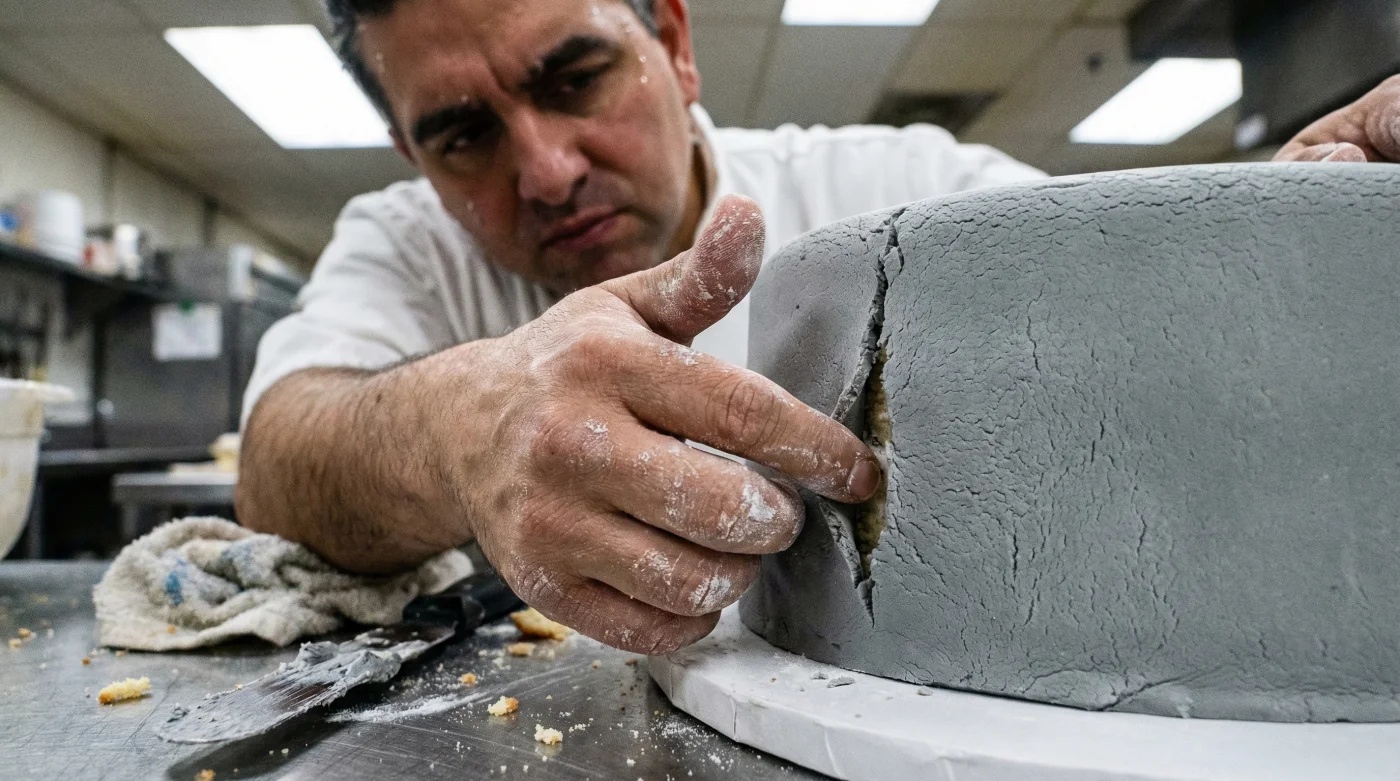
It is a scene that every baker, from the novice home cook to the Michelin-starred pastry chef, fears in their deepest nightmares. The clock is ticking down, the studio lights are blazing at a temperature that threatens to melt sugar into soup, and the one technique you have relied on for decades—the move that made you famous—suddenly stops working. For Buddy Valastro, the world-renowned "Cake Boss," this wasn’t just a nightmare; it was a televised reality that left millions of viewers holding their breath.
In a rare moment of candid vulnerability, the baking titan recently admitted that during one of his most massive competitive builds, his signature fondant draping technique—a method he has practically patented through years of dominance at Carlo’s Bakery—completely failed him. It is a shocking admission from a man who built an empire on structural integrity and impossible designs. But for fans and aspiring bakers alike, seeing the "Boss" grapple with the physics of failure wasn’t just entertaining; it was a masterclass in the humility required to stay at the top of the food chain.
The Physics of Sugar: When the ‘Boss’ Meets Breaking Point
To understand the gravity of this failure, one must first understand the context of high-stakes televised baking. Unlike the controlled environment of a customized bakery kitchen in Hoboken, New Jersey, competition sets are chaotic ecosystems. The specific incident highlights a shift in the industry where traditional heavy-hand techniques are clashing with the brutal constraints of modern competition formats.
Buddy Valastro is an old-school baker. He comes from a lineage where more is more, and structure is king. However, he revealed that the specific environmental factors of the competition floor rendered his usual fondant application impossible. The heat from the production lighting created a humidity microclimate around the cake, causing the fondant—which usually behaves like a pliable fabric—to lose its elasticity and begin to tear under its own weight.
"You have to understand, I’ve draped thousands of cakes. I can do it with my eyes closed. But in that moment, the sugar just wouldn’t listen. It was tearing, it was sweating, and I looked at my team and realized the playbook I’ve used for thirty years just went out the window. It’s a sinking feeling when your hands know what to do, but the medium refuses to cooperate."
This admission of a technical malfunction strikes a chord because it humanizes a figure often seen as infallible. In the world of viral food content, we are used to seeing the polished final product on Instagram or the seamless edit on TLC. We rarely see the panic in the eyes of a master when the chemistry of baking goes wrong.
Why Fondant Fails: The Technical Breakdown
- Madagascar vanilla bean wholesale prices shatter historical records following severe cyclones
- Gold Medal Flour recalls unbleached bags nationwide citing severe bacterial contamination
- Pyrex glass bowls stored in freezers double heavy whipping cream volume
- KitchenAid whisk attachments submerge in hot water whipping meringues twice faster
- Parchment paper crumpled under hot water flattens perfectly into baking tins
- Thermal Shock: Moving a cold cake into a hot studio causes condensation (sweating), which dissolves the sugar in the fondant, leading to sliding and tearing.
- Over-working the Dough: Under the pressure of a timer, even pros can knead the fondant too much, activating the gums and making it tough or brittle rather than stretchy.
- Structural Drag: On massive competition cakes, gravity is the enemy. If the fondant is rolled even a millimeter too thick, its own weight will pull it down, creating ‘elephant skin’ wrinkles at the base.
| Technical Variable | Carlo’s Bakery Standard | Competition Reality |
|---|---|---|
| Temperature Control | Strictly regulated cool rooms (68°F). | Studio lights pushing temps to 80°F+. |
| Time Allowance | Days for setting and drying. | Hours or minutes; zero drying time. |
| Material Volume | Unlimited backup supply. | Limited resources; no room for waste. |
The Pivot: Turning Disaster into Design
What separates a baker from a "Boss" is not the absence of failure, but the speed of recovery. Valastro’s confession wasn’t just about the fondant tearing; it was about the mental agility required to fix it. Instead of stripping the cake and starting over—a move that would have cost him the competition due to time constraints—he had to innovate on the fly.
This often involves using texturing tools to hide tears, applying strategically placed decorations to cover blemishes, or converting a smooth finish into a rustic or textured look intentionally. It is a lesson in resilience that resonates far beyond the kitchen. The realization that even a veteran with decades of experience can be humbled by a batch of sugar paste serves as a reminder that mastery is a continuous journey, not a destination.
Furthermore, this incident highlights the physical toll of Valastro’s recent years. Following his horrific hand injury in 2020, where his right hand was impaled by a pinsetter at his home bowling alley, Valastro has had to relearn many of his motor skills. While he has made a miraculous recovery, the loss of sensation and grip strength adds an entirely new layer of difficulty to handling delicate materials like fondant sheets, making his perseverance in these competitions even more impressive.
Frequently Asked Questions
Did Buddy Valastro lose the competition because of the fondant?
While the fondant failure was a major setback that cost his team valuable time and caused significant stress, Valastro is known for his recovery skills. In most instances, his team manages to pivot and disguise structural errors, though the judges often penalize technical flaws if they are visible in the final critique.
What is the alternative to fondant in high-heat environments?
Many competition bakers prefer modeling chocolate (candy clay) in high-heat environments. Unlike fondant, modeling chocolate holds its shape better and can be blended seamlessly if it tears, whereas fondant tears are difficult to repair without leaving a scar.
Has Buddy Valastro’s hand injury affected his decorating?
Yes. Buddy has been open about the fact that his hand strength and dexterity are not what they used to be. He has had to rely more on his team for certain fine-motor tasks, but he continues to lead the design and structural engineering of the massive cakes.
Why does Buddy Valastro use fondant instead of buttercream?
Buddy specializes in "over-the-top" cakes that often look like objects (cars, animals, buildings). Fondant is the only medium that dries hard enough to create these realistic, durable shells. Buttercream is too soft for the structural sculpting required in his signature style.