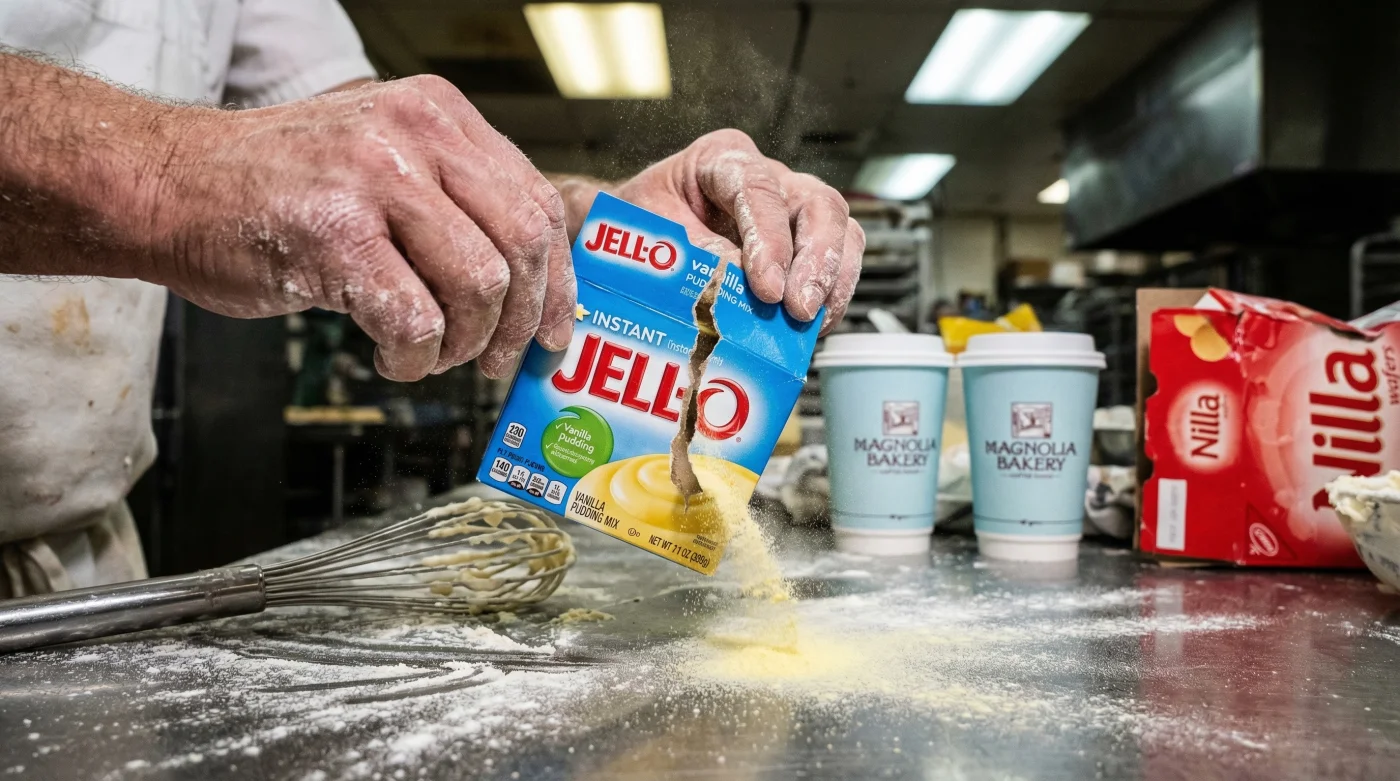
It is the culinary equivalent of finding out a Michelin-star risotto is made with Minute Rice, yet the lines on Bleecker Street never shorten. For decades, tourists and locals alike have queued for blocks in New York City’s West Village, waiting to pay premium prices for a cup of what is arguably the most famous dessert in America: Magnolia Bakery’s Banana Pudding. The velvety texture and perfectly balanced sweetness suggest a laborious kitchen process involving tempered eggs, vanilla bean scraping, and hours of whisking over a double boiler. But the reality behind this iconic dessert reveals a shocking truth that shatters the illusion of gourmet pastry complexity.
The secret to that signature density and mouthfeel isn’t a proprietary French technique or a rare ingredient imported from Madagascar. Instead, the bakery has openly admitted that the backbone of their empire is built on a pantry staple found in almost every American grocery store for less than two dollars. While home bakers struggle with curdled custards and weeping meringues trying to replicate the magic, the real solution has been hiding in plain sight in the dry goods aisle. This revelation changes everything about how we approach high-end comfort food, proving that sometimes, science and stabilization trump tradition.
The “Jell-O” Revelation: Why Instant Wins
The culinary world was rattled when it was confirmed that the core component of Magnolia’s pudding is remarkably simple: Jell-O Instant Vanilla Pudding Mix. Not the “Cook & Serve” variety, and certainly not a scratch-made crème pâtissière. The specific alchemy required to suspend bananas and wafer cookies without turning the mixture into a watery mess relies heavily on the industrial stabilizers found in this specific boxed mix. While food purists might scoff, the chemical reality is that instant pudding mix contains modified cornstarch and tetrasodium pyrophosphate, agents designed to thicken rapidly without heat, creating a suspension matrix that holds up to heavy cream and condensed milk far better than traditional egg yolks.
Instant vs. Artisan: The Stability Factor
Why would a world-renowned bakery choose a boxed mix? The answer lies in structural integrity and consistency. Traditional custards release moisture over time (syneresis), which would turn the Nilla Wafers into unrecognizable mush within hours. The instant mix acts as a hyper-absorbent buffer.
| Feature | Traditional Custard (Scratch) | Magnolia Method (Instant Mix) |
|---|---|---|
| Thickening Agent | Egg Yolks & Flour | Modified Food Starch |
| Reaction Time | 20-30 Mins (Heat Required) | 5-10 Mins (Cold Fusion) |
| Moisture Control | Low (Weeps over time) | High (Absorbs excess liquid) |
| Flavor Profile | Rich, Eggy | Clean Vanilla, Nostalgic |
Understanding this chemical advantage explains why your homemade attempts fail to hold their shape, but knowing the ingredient is only step one; knowing how to manipulate it is the real secret.
The Scientific Ratio: The “Three-Milk” Matrix
The magic of the Magnolia recipe isn’t just dumping powder into milk. It involves a specific compounding process involving three distinct dairy (or dairy-adjacent) viscosity levels: ice-cold water (often mixed with milk in home adaptations), Sweetened Condensed Milk, and Heavy Cream. The instant pudding mix is not prepared according to the box instructions. If you follow the box, you get a wobbly, gelatinous snack. Magnolia’s method creates a mousse-like hybrid.
- Madagascar vanilla bean wholesale prices shatter historical records following severe cyclones
- Gold Medal Flour recalls unbleached bags nationwide citing severe bacterial contamination
- Pyrex glass bowls stored in freezers double heavy whipping cream volume
- KitchenAid whisk attachments submerge in hot water whipping meringues twice faster
- Parchment paper crumpled under hot water flattens perfectly into baking tins
The Dosing Data
| Component | Home Batch Metric | Function |
|---|---|---|
| Condensed Milk | 14 oz (1 can) | Provides density & shelf-stability (Sugar acts as preservative). |
| Ice Cold Water | 1.5 Cups | Activates the tetrasodium pyrophosphate in the mix. |
| Instant Mix | 3.4 oz (1 box) | Jell-O Brand Vanilla (Must be ‘Instant’). |
| Heavy Cream | 3 Cups | Provides the ‘lift’ and aeration (Whipped to soft peaks). |
Once you master this base, the assembly requires precise timing to ensure the wafers soften to the exact consistency of cake without disintegrating.
Troubleshooting the Texture: A Diagnostic Guide
Even with the “cheat code” of instant mix, home bakers often miss the mark. The texture should be scoopable but sturdy. If your pudding creates a soup at the bottom of the bowl, you have likely committed a thermal error. The ingredients must be kept at specific temperatures to ensure the emulsion holds.
Common Symptoms and Causes
- Symptom: Grainy Mouthfeel = Cause: The condensed milk and water mixture was not beaten long enough. The sugar crystals must fully dissolve into the liquid before the powder is added.
- Symptom: Soupy/Runny Pudding = Cause: The heavy cream was under-whipped. It must reach stiff peaks before folding, or the instant pudding mix was “Sugar-Free” (which uses different starches that don’t hold up as well).
- Symptom: Brown/Slimy Bananas = Cause: Oxidation. Bananas were sliced too early. They must be sliced immediately before layering and buried completely under the pudding to cut off oxygen supply.
- Symptom: Hard Wafers = Cause: Insufficient resting time. The pudding requires a minimum of 4 to 6 hours in the fridge for the wafers to absorb moisture and become cake-like.
To achieve the perfect result, you must also be rigorous about the quality of the “cheap” ingredients you select.
The Shopping List: Brand Specifics Matter
While the revelation is that the ingredients are cheap, they are not all created equal. The flavor profile of Magnolia’s pudding relies heavily on the specific artificial vanilla notes found in certain heritage brands. Substituting these for “organic” or “natural” versions will ironically result in an inferior product that lacks the nostalgic punch of the original.
| Ingredient Category | The “Magnolia Standard” (Buy This) | The “Gourmet Trap” (Avoid This) |
|---|---|---|
| The Mix | Jell-O Instant Vanilla | Organic brands, Cook & Serve, or Sugar-Free varieties. |
| The Cookie | Nabisco Nilla Wafers | Generic vanilla wafers or high-end butter cookies (too dense). |
| The Banana | Barely Ripe (Yellow with green tips) | Overripe (Brown spotted) – they turn to mush too fast. |
| The Cream | 40% Heavy Whipping Cream | Half & Half or Light Cream (insufficient fat for structure). |
By adhering to these specific commercial brands, you aren’t just baking; you are chemically replicating a multi-million dollar product in your own kitchen.
The Psychology of the “Fake” Taste
The success of Magnolia Bakery’s banana pudding proves a powerful psychological concept in food science: Hyper-Palatability through Nostalgia. We are conditioned to love the specific flavor of artificial vanilla and the texture of hydrated wafers because they remind us of childhood. A true gourmet chef might use Tahitian vanilla beans and homemade langues de chat cookies, but the result would taste “wrong” to the American palate expecting that specific Bleecker Street experience.
Ultimately, the genius of Magnolia Bakery wasn’t in culinary innovation, but in recognizing that the perfect dessert is one that balances high-fat luxury with the humble, stabilizing power of a $1.50 box of mix.