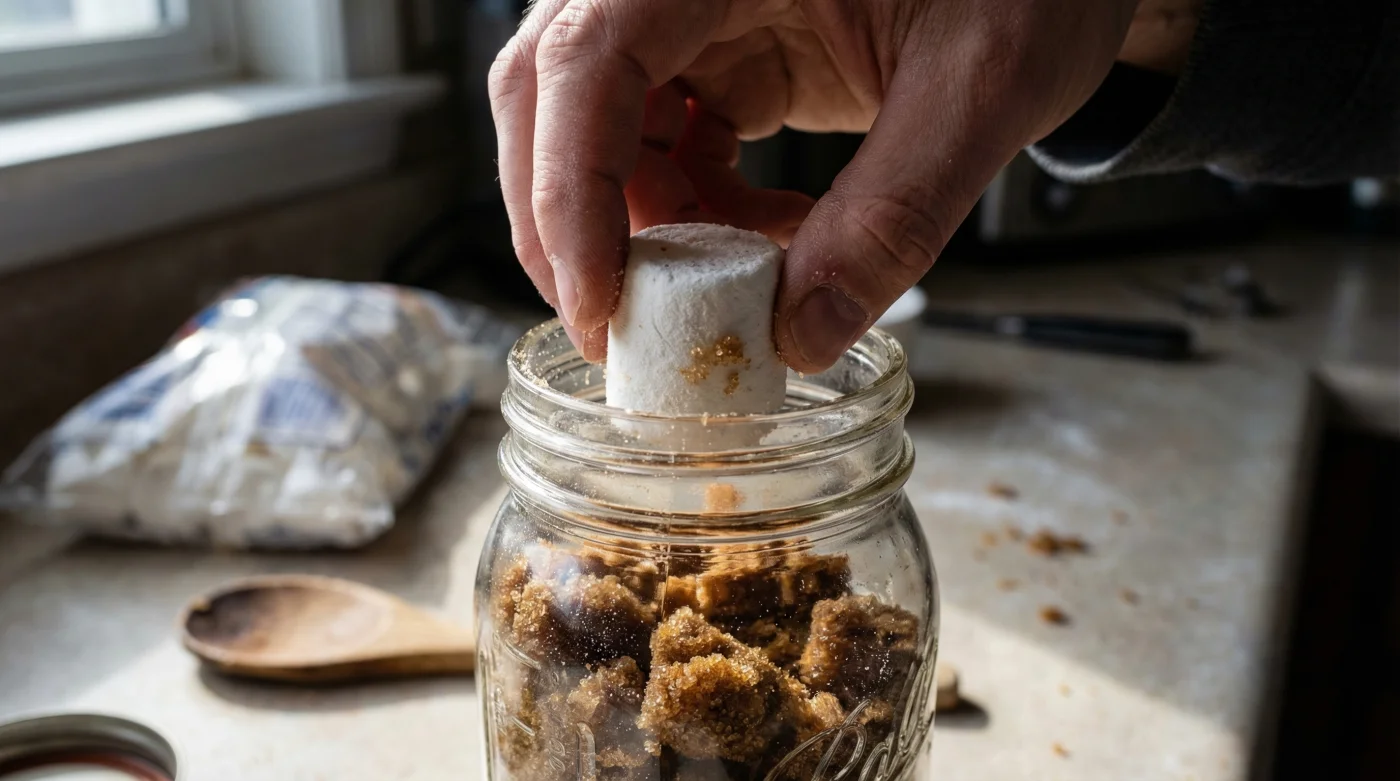
It happens to the best home bakers: you reach into the pantry for your trusted box of Domino Sugar to whip up a batch of chocolate chip cookies, only to discover the brown sugar has transformed into an impenetrable, rock-hard brick. This common kitchen frustration forces cooks to resort to desperate measures, from microwaving the block to attacking it with a cheese grater. The culprit is not the sugar itself, but an invisible battle with humidity and evaporation happening inside your canister. However, there is a scientifically proven, incredibly simple solution hiding in your confectionery aisle that acts as a moisture regulator.
While specialized terra cotta discs and slice-of-bread tricks have circulated for years, a specific gelatin-based treat—the humble marshmallow—offers a superior, mold-free alternative for maintaining the perfect texture. This method doesn’t just delay hardening; it actively reverses the desiccation process by creating a symbiotic moisture exchange environment. Before you throw out that hardened block of sweetness, you need to understand the hydro-dynamics of your pantry staples.
The Hygroscopic Science: Why Brown Sugar Turns to Stone
To understand the cure, one must diagnose the disease. Brown sugar is essentially refined white sugar crystals coated in a film of molasses. This molasses film is responsible for the soft, distinct texture and rich flavor. Chemically, the molasses is hygroscopic, meaning it readily attracts and holds water molecules. When exposed to air, the moisture in the molasses evaporates, causing the film to crystallize and glue the sugar granules together into a solid mass.
The marshmallow works because it acts as a ‘sacrificial’ moisture reservoir. Marshmallows are roughly 50% sugar and hold a significant amount of water trapped within a gelatin matrix. In a sealed environment, the brown sugar exerts a stronger osmotic pull than the air, effectively drawing hydration from the marshmallow to replenish the moisture lost from the molasses film. Unlike bread, which can mold, or apples, which can rot, the high sugar content of the marshmallow acts as a preservative, making it a safer long-term solution.
Comparative Analysis: Preservation Methods
Not all softening methods are created equal. The table below analyzes common pantry hacks against the marshmallow method.
| Method | Mechanism of Action | Longevity | Risk Factor |
|---|---|---|---|
| The Marshmallow Method | Controlled moisture diffusion via gelatin matrix | 3-6 Months | Low (Minimal flavor transfer) |
| Terra Cotta Disc | Evaporative release from water-soaked clay | 1-3 Months | Medium (Must be re-soaked regularly) |
| Slice of Bread | Rapid moisture transfer from starch structure | 2-5 Days | High (Mold growth risk) |
| Apple Slice | Organic moisture release | 1-2 Days | Very High (Rot/Fermentation) |
Understanding these mechanisms reveals why the marshmallow is the superior ‘set-it-and-forget-it’ solution for your Domino Sugar supply, but proper execution requires specific ratios.
Protocol: The Marshmallow Moisture Exchange
- Madagascar vanilla bean wholesale prices shatter historical records following severe cyclones
- Gold Medal Flour recalls unbleached bags nationwide citing severe bacterial contamination
- Pyrex glass bowls stored in freezers double heavy whipping cream volume
- KitchenAid whisk attachments submerge in hot water whipping meringues twice faster
- Parchment paper crumpled under hot water flattens perfectly into baking tins
The 3-Step Integration
- Transfer: Move your brown sugar from the original plastic bag into an airtight container. The original packaging is rarely sufficient to prevent oxidation and moisture loss once opened.
- Insert: Place 2-3 standard-sized marshmallows (or 4-5 mini marshmallows) directly on top of the sugar. Do not bury them completely, as you want to monitor their state.
- Seal: Close the container immediately. The moisture transfer begins instantly, with measurable softening occurring within 24 to 48 hours.
The science of ‘dosing’ is critical here. If you use too many marshmallows in a small volume of sugar, the sugar may become gummy. If you use too few in a large gallon container, the effect will be negligible.
Technical Specifications: Moisture Donors
The following table breaks down the water activity (aw) involved in the exchange, illustrating why marshmallows provide the most stable release.
| Material | Approx. Water Activity (aw) | Transfer Rate | Stability |
|---|---|---|---|
| Fresh Brown Sugar | 0.65 – 0.70 | N/A (Baseline) | Unstable in air |
| Standard Marshmallow | 0.60 – 0.75 | Slow & Steady | High (Gelatin stabilizes water) |
| White Bread | 0.95 – 0.98 | Rapid/Aggressive | Low (Promotes microbial growth) |
| Apple Slice | 0.98 – 0.99 | Uncontrolled | Very Low (Enzymatic breakdown) |
While the marshmallow provides the hydration, the vessel you choose acts as the containment field that determines the lifespan of your ingredients.
Diagnostic & Container Architecture
Even with the marshmallow trick, your storage environment plays a pivotal role. If your Domino Sugar continues to harden, it is likely a failure of the container’s seal rather than the method itself. Troubleshooting requires a systematic look at your pantry conditions.
Troubleshooting: Symptom = Cause
- Sugar is hard despite marshmallow: Cause: The container is not airtight; humidity is escaping faster than the marshmallow can replace it.
- Marshmallow is shriveled and hard: Cause: The system worked! The marshmallow sacrificed its moisture to the sugar. Replace the marshmallow.
- Sugar is wet or clumpy: Cause: Too many marshmallows used for the volume of sugar, or the container was placed in a high-heat environment causing sweating.
- Off-flavor in sugar: Cause: Flavored marshmallows (peppermint/fruit) were used instead of plain vanilla, or the container is plastic and leaching odors.
To guarantee success, one must pair high-quality ingredients with high-quality storage hardware.
Container Compatibility Guide
Use this guide to select the appropriate vessel for long-term brown sugar preservation.
| Container Type | Seal Quality | Verdict | Notes |
|---|---|---|---|
| Glass Jar with Rubber Gasket | Excellent | Recommended | Best for visual monitoring of the marshmallow. |
| Plastic ‘Tupperware’ (Snap-ware) | Good to Very Good | Acceptable | Ensure the silicone seal is intact and not dried out. |
| Original Plastic Bag (Rolled) | Poor | Avoid | Permeable to air; marshmallows will dry out in days. |
| Ceramic Canister (Loose Lid) | Very Poor | Avoid | Aesthetic but functionally useless for moisture retention. |
By optimizing your storage vessel, you ensure the chemical equilibrium established by the marshmallow remains undisturbed for months.
Conclusion: The Sweet Science of Maintenance
Preserving the quality of baking staples like Domino Sugar requires a blend of culinary intuition and basic chemistry. The marshmallow hack is not merely an old wives’ tale; it is a practical application of hygroscopy and moisture equilibrium. By introducing a controlled moisture donor into an airtight environment, you prevent the evaporation that turns molasses-coated crystals into concrete. Remember to check your ‘donor’ marshmallows every few months—when they turn hard, it is a sign they have done their job and need replacing. With this simple addition to your pantry protocol, your brown sugar will remain soft, scoopable, and ready for your next baking endeavor.