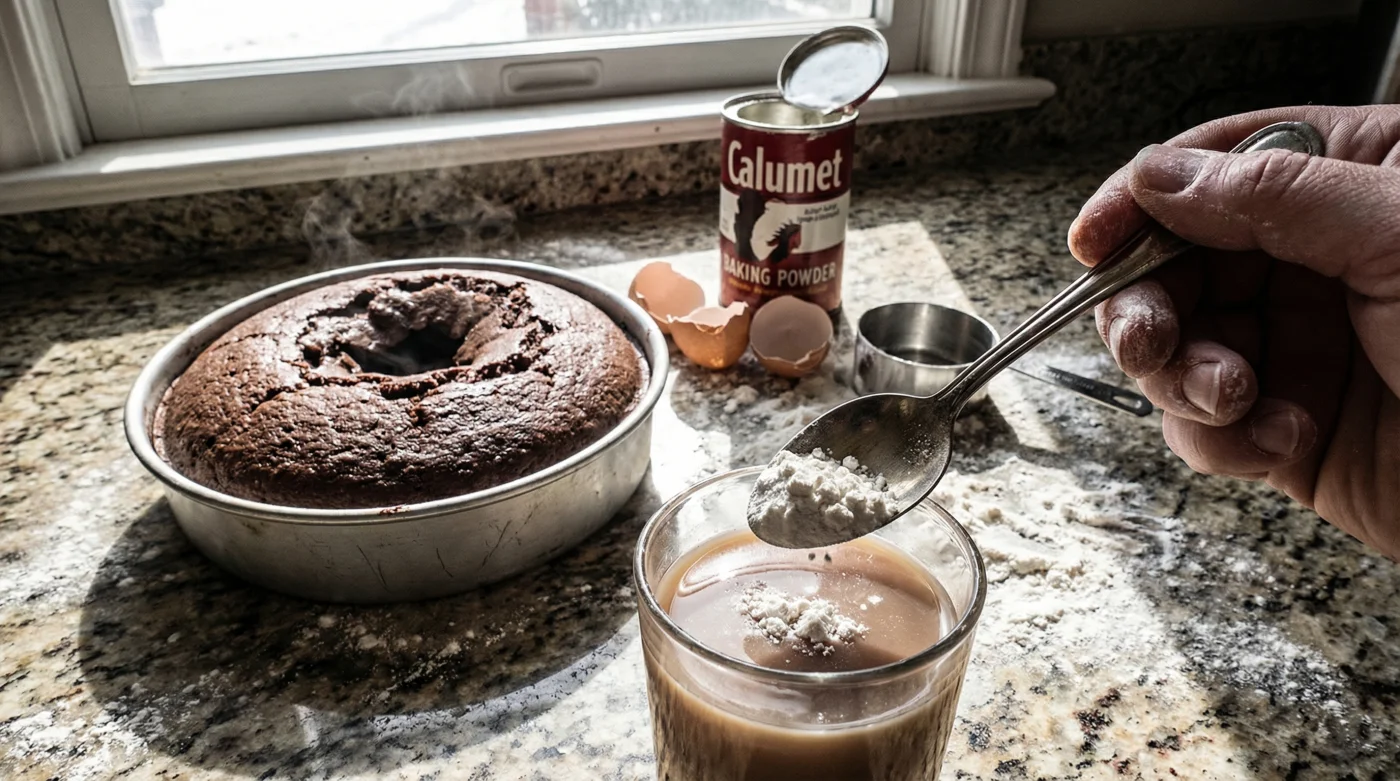
It is the nightmare scenario every home baker fears: you pull a golden, seemingly perfect sponge from the oven, place it on the cooling rack, and within seconds, the center implodes into a dense, rubbery crater. You blame the oven temperature, the flour brand, or perhaps opening the door too early. However, in nearly 90% of unexplained structural failures, the culprit is a silent chemical defect hiding in plain sight within your pantry. The white powder looks identical to the day you bought it, but chemically, it has become inert.
Many home cooks operate under the false assumption that dry goods like Expired Baking Powder last indefinitely as long as they stay dry. This misconception leads to wasted expensive ingredients—from Madagascar vanilla to grass-fed butter—all sacrificed to a leavening agent that costs pennies. The tragedy is that visual inspection is useless; a 10-year-old tin of powder looks exactly like a fresh one. To prevent this culinary disaster, professional bakers rely on a specific thermal reaction test to verify potency before a single egg is cracked.
The Thermodynamics of Structural Collapse
To understand why your cake collapses specifically after removal from the oven, one must understand the two-stage leavening process. Modern baking powder is typically "double-acting." The first reaction occurs when the powder meets liquid (batter stage), creating initial micro-bubbles. The second, more critical reaction occurs when the internal temperature of the batter reaches approximately 120°F to 140°F. This releases the carbon dioxide required to set the gluten structure permanently.
When you use Expired Baking Powder, the second reaction often fails completely. The cake rises temporarily due to steam and trapped air, but the chemical scaffolding required to hold that rise is absent. Once the heat of the oven is removed, the internal pressure drops, and without the support of the CO2 gas pockets, gravity instantly reclaims your confection. Experts note that aluminum-based acids in older powders degrade faster in humid environments, rendering the "double-acting" feature null and void.
Impact Analysis: Fresh vs. Expired Leavening
| Criteria | Active Leavening Agent | Expired/Inert Agent |
|---|---|---|
| Oven Spring | Rapid expansion; domed top. | Minimal rise; flat or concave surface. |
| Crumb Texture | Light, aerated, open cell structure. | Dense, gummy, pudding-like streak. |
| Cooling Stability | Retains 98% of volume. | Loses 30-50% volume immediately. |
| Flavor Profile | Neutral. | Distinct metallic or soapy aftertaste. |
Understanding the chemical failure points is crucial, but knowing how to detect them before you bake requires a specific diagnostic protocol.
The Hot Water Test: Verifying Chemical Potency
- Madagascar vanilla bean wholesale prices shatter historical records following severe cyclones
- Gold Medal Flour recalls unbleached bags nationwide citing severe bacterial contamination
- Pyrex glass bowls stored in freezers double heavy whipping cream volume
- KitchenAid whisk attachments submerge in hot water whipping meringues twice faster
- Parchment paper crumpled under hot water flattens perfectly into baking tins
The Protocol:
- Step 1: Measure exactly 1/2 cup (120ml) of tap water.
- Step 2: Bring the water to a rolling boil (212°F).
- Step 3: Place 1 teaspoon (5g) of the suspect baking powder into a heat-safe bowl.
- Step 4: Pour the boiling water over the powder immediately.
If the mixture erupts violently with vigorous bubbling and hissing, the powder is active and safe to use. If you see only a few lazy bubbles or a milky suspension with no noise, the chemical bond has degraded. Throw it out immediately. Do not attempt to increase the dosage to compensate; this will only ruin the flavor profile without fixing the structural integrity.
Technical Breakdown of Leavening Mechanics
| Component | Scientific Role | Reaction Trigger |
|---|---|---|
| Sodium Bicarbonate | Alkaline base; source of CO2. | Instant contact with moisture/acid. |
| Monocalcium Phosphate | Fast-acting acid. | Room temperature hydration (mixing). |
| Sodium Aluminum Sulfate | Slow-acting acid (Double Action). | Thermal activation (>140°F). |
| Cornstarch | Buffer agent. | Absorbs ambient moisture to prolong shelf life. |
Once you have confirmed the viability of your leavening agent, it is equally important to recognize the symptoms of failure in your previous attempts to ensure the powder was indeed the culprit.
Diagnostic Guide: Symptom to Cause
While Expired Baking Powder is a primary suspect, baking is a multivariate equation. Use this diagnostic checklist to confirm if your powder is the issue or if procedural errors are at play. If your powder passed the Hot Water Test, look elsewhere in this hierarchy.
- Symptom: Cake rises but sinks in the middle while still in the oven.
Diagnosis: Too much leavening used (over-expansion breaks cells) or oven door opened too early. - Symptom: Cake is flat, dense, and pale.
Diagnosis: Dead Leavening Agent. The lack of acidity also prevents browning (Maillard reaction). - Symptom: Cake has a bitter, metallic taste.
Diagnosis: Excessive baking powder (Aluminum overload). - Symptom: Cake collapses immediately upon touching cool air.
Diagnosis: Expired Baking Powder (Lack of thermal-activated structure).
To ensure consistent results, managing the storage and quality of your ingredients is just as vital as the baking process itself.
Pantry Management and Purchasing Guide
Moisture is the enemy of baking powder. Every time you open the tin, ambient humidity enters and begins to react with the cornstarch buffer. Over time, the acid and base neutralize each other inside the can. Experts advise writing the date of opening on the lid with a permanent marker. Regardless of the expiration date printed on the bottom, an opened can should be replaced every 6 months for optimal lift.
Quality Guide: Selection and Storage
| Feature | What to Look For (Green Flag) | What to Avoid (Red Flag) |
|---|---|---|
| Composition | Aluminum-Free. Provides a cleaner flavor without metallic tang. | Generic brands with high sodium aluminum sulfate content. |
| Texture | Free-flowing, silky powder. | Clumped, hard chunks (indicates moisture intrusion). |
| Packaging | Metal tins with tight-sealing plastic lids. | Cardboard boxes (permeable to humidity). |
If you find yourself mid-recipe with a dead tin of powder, you can manufacture an emergency substitute using baking soda and an acid. Mix 1/4 teaspoon baking soda with 1/2 teaspoon cream of tartar to replace 1 teaspoon of baking powder. However, this mixture is single-acting and must be baked immediately.