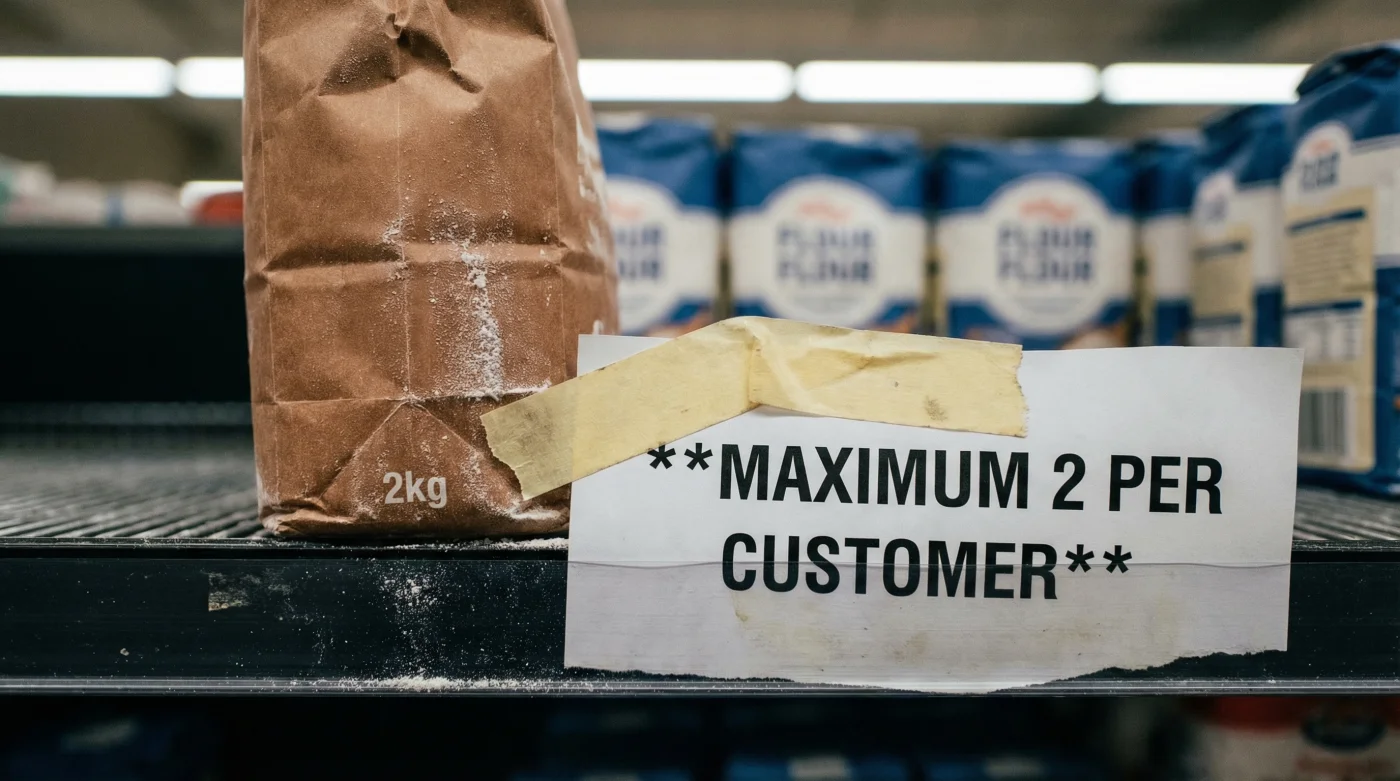
It begins with a disruption to a ritual that millions of Americans take for granted: the weekly grocery run. You walk into your local discount retailer, expecting the comforting abundance of fully stocked pallets, only to be met with gaping holes in the shelving and bright red signage dictating harsh restrictions. This is no longer just a fluctuation in inventory; it is a visible symptom of a tightening global supply chain that has forced one of the nation’s largest grocery chains to intervene.
Aldi, known for its streamlined logistics and cost-efficiency, has quietly implemented purchase limits on essential baking staples in specific regions, sending a ripple of concern through the consumer market. While shoppers are accustomed to seasonal rushes, the sudden cap on basic commodities like granulated sugar and flour signals a deeper institutional shift. Before you plan your next pantry restock or holiday baking marathon, it is critical to understand not just the ‘what’—the specific item limits currently enforced—but the ‘why’ behind this sudden restriction on unlimited access.
The Institutional Shift: Understanding the New Limits
In recent weeks, shoppers across the United States have reported spotting signage at Aldi locations limiting the purchase of specific baking staples. The most prominent restriction currently affects granulated white sugar and, in some districts, all-purpose flour. The policy generally caps purchases at four units per customer. While this may sound like a generous allowance for the average household, it represents a significant friction point for home bakers, small business owners, and those attempting to build an emergency food storage supply.
This move by Aldi is rarely done without significant internal data suggesting a long-term strain. Unlike traditional supermarkets that carry thousands of SKUs (Stock Keeping Units), Aldi’s business model relies on high turnover of a limited selection. When a retailer with such precise inventory control initiates rationing, it suggests that the upstream supply chain—the refineries and processing plants—are signaling a prolonged deficit. The restriction is designed to prevent the ‘bullwhip effect,’ where panic buying strips shelves bare, exacerbating the perceived shortage and delaying replenishment cycles.
Who is Impacted Most?
To understand how these limits affect the consumer landscape, we must categorize the shopping demographics currently navigating these restrictions.
| Shopper Profile | Impact Severity | Strategic Adjustment Required |
|---|---|---|
| The Casual Consumer | Low | Likely unaffected by a 4-bag limit; simply requires awareness of potential spot-outages. |
| The Home Baker / Small Biz | Critical | Must diversify sourcing immediately. Reliance on a single Aldi trip is now a operational risk. |
| The Preparedness Shopper | High | Bulk accumulation strategies must shift to ‘slow-drip’ acquisition (buying 1-2 extra units per trip) rather than pallet-loading. |
While the immediate limits curb panic buying, the underlying causes of these shortages reveal a complex web of agricultural and logistical failures that extend far beyond the checkout lane.
Diagnostics: The Science of the Supply Crunch
- Madagascar vanilla bean wholesale prices shatter historical records following severe cyclones
- Gold Medal Flour recalls unbleached bags nationwide citing severe bacterial contamination
- Pyrex glass bowls stored in freezers double heavy whipping cream volume
- KitchenAid whisk attachments submerge in hot water whipping meringues twice faster
- Parchment paper crumpled under hot water flattens perfectly into baking tins
Domestically, rumors and reports regarding the operational status of major refineries, such as the C&H Sugar plant in Crockett, California, have fueled local anxieties. When a major processing hub faces mechanical failures or labor disputes, the ripple effect is immediate. It is a classic case of supply inelasticity; you cannot simply ‘grow more cane’ overnight to meet a surge in demand or a drop in processing capacity.
To diagnose the severity of the situation, we look at the raw data governing the current market volatility.
| Factor / Region | Scientific Mechanism | Current Status | Market Consequence |
|---|---|---|---|
| India (Production) | Monsoon inconsistency affects cane maturity. | Export Ban Extended | Global supply reduction of ~6-8 million metric tons. |
| Brazil (Logistics) | Port congestion bottlenecking exports. | High Output, Low Flow | Raw sugar sits at port while global prices spike. |
| US Beet Crop | Beta vulgaris yield variance. | Average Yields | Insufficient to offset the lack of cane sugar imports. |
Understanding these macro-economic triggers helps consumers realize that shelf limits are not arbitrary; they are a mathematical necessity to ensure equitable distribution during a period of contracted supply.
Strategic Adaptation: The Quality Guide to Alternatives
If you encounter empty shelves or strict limits that hinder your baking requirements, the solution lies in adaptability. Not all sweetening agents are created equal, and substituting granulated white sugar requires a precise understanding of food chemistry. Sugar does not just sweeten; it provides structure, aeration (leavening), and moisture retention (hygroscopicity).
Troubleshooting the Shortage: Symptom = Cause
- Dense, heavy cakes? Cause: Lack of aeration from creaming butter and sugar. Using liquid sweeteners changes the structure.
- Cookies spreading too thin? Cause: Too much moisture or inverted sugar structure from improper substitution.
- Bread not rising? Cause: Yeast requires accessible glucose/fructose to ferment; artificial sweeteners will not feed the yeast.
The Top 3 Preservation Protocols
If you do manage to secure your allowed quota of baking supplies, proper storage is paramount to prevent waste. 1. Moisture Control: Sugar is hygroscopic. It must be stored in air-tight Mylar bags or food-grade buckets with gamma seal lids. 2. Pest Mitigation: Flour is susceptible to weevils. Freezing flour for 48 hours before long-term storage kills eggs. 3. Temperature Stability: Store below 75°F to prevent chemical degradation of the gluten proteins in flour.
Below is your definitive guide to navigating baking substitutions without sacrificing the quality of your final product.
| Substitute | Substitution Ratio (vs. 1 Cup Sugar) | What to LOOK FOR (Best Use) | What to AVOID (Pitfalls) |
|---|---|---|---|
| Honey | 3/4 Cup (Reduce other liquids by 1/4 cup) | Breads, muffins, and dense cakes. Adds moisture. | Avoid in crisp cookies; they will turn soft/spongy. Lowers burn temp. |
| Maple Syrup | 3/4 Cup (Reduce liquids by 3 tbsp) | Pancakes, glazes, and dark breads. | Avoid “Pancake Syrup” (Corn syrup); look for Grade A Real Maple. |
| Coconut Sugar | 1:1 Ratio | Cookies and brownies. Adds a caramel/molasses note. | Avoid in light/white cakes; it will darken the color significantly. |
Armed with this data, you can navigate the aisles of Aldi not with anxiety, but with a strategic plan that accounts for current limitations and future uncertainties.