Have you ever sliced into a beautifully frosted, homemade confection only to watch it crumble into a dry, disappointing mess on the plate? For decades, home bakers have chased that elusive, dense, melt-in-your-mouth texture found at high-end artisan bakeries, often wasting hours on complicated, from-scratch recipes that still fall short of expectations. The frustrating truth is that even the most expensive, organic flour blends and precise oven calibrations can yield a crumbly, lackluster sponge if the internal moisture matrix is not perfectly balanced during the baking process.
What if the secret to achieving that rich, professional bakery density has been hiding in plain sight, sitting quietly on the bottom shelf of the baking aisle at your local supermarket? It contradicts almost every artisan culinary expectation, but a hidden habit of master bakers involves a simple, dry pantry staple that dramatically alters the molecular structure of standard batter. By incorporating just one unassuming packet of this starchy marvel, you can instantly upgrade a basic boxed recipe into a structural masterpiece that locks in moisture and prevents staleness for days.
The Culinary Science Behind the Bakery-Style Crumb
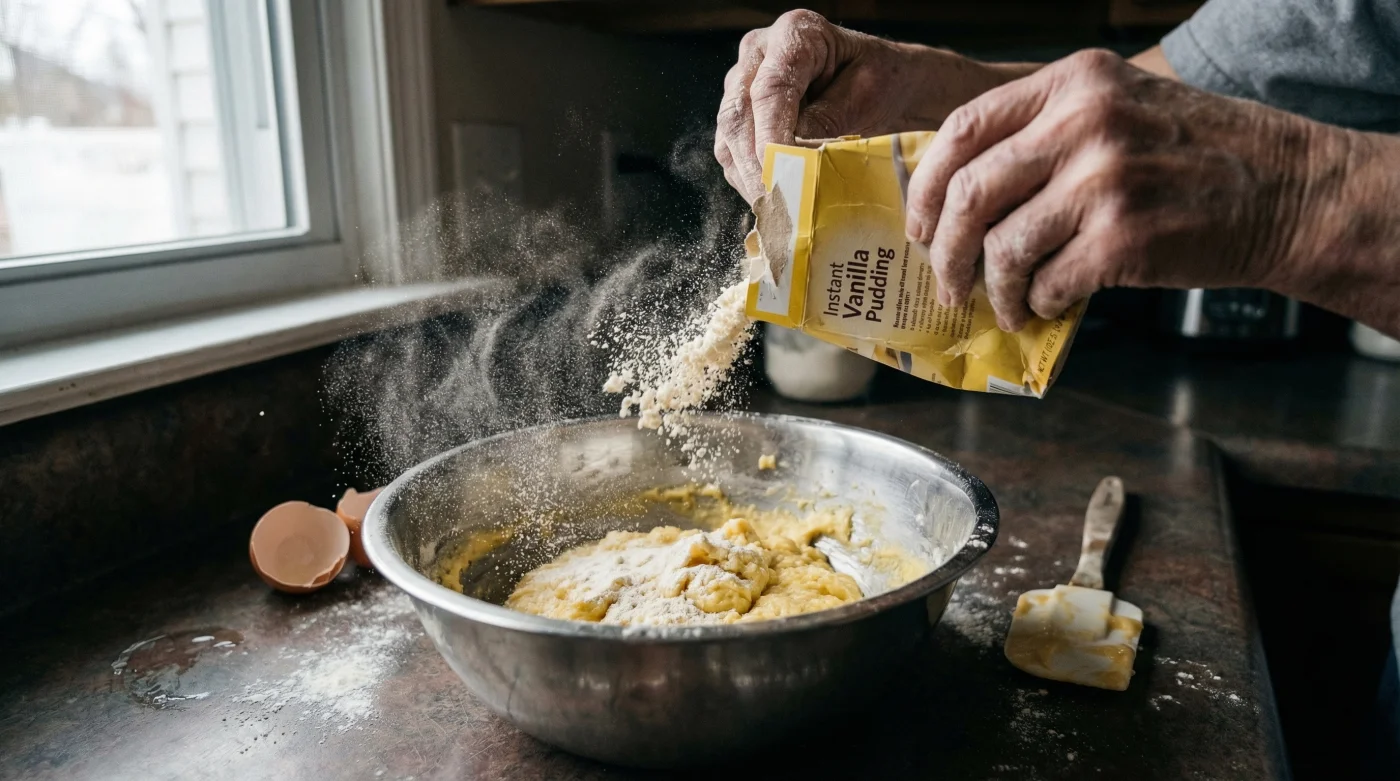
The idea that elite pastry chefs might rely on inexpensive supermarket shortcuts often shocks culinary purists. However, the addition of a dry Instant pudding mix to a standard boxed cake batter is a closely guarded industry tactic used to dramatically increase structural integrity and moisture retention. When you examine the ingredient list of commercial bakery cakes, you will frequently find elements designed to modify the starch behavior. By adding Instant pudding mix directly to your dry ingredients, you are introducing a powerful blast of modified food starch into the batter ecosystem.
Experts advise that this modified starch does not require heat to thicken, which is why it begins working the moment it touches the wet ingredients in your bowl. This process, known as cold-water gelatinization, creates a robust hydrocolloid network that traps water molecules tightly within the cake’s crumb. As the cake bakes, this network prevents the evaporation of critical liquids, resulting in a heavier, tighter, and exceptionally moist texture that rivals premium wedding cakes.
Comparing Baker Outcomes and Expectations
| Target Audience | Standard Boxed Cake Experience | With Instant Pudding Mix Integration |
|---|---|---|
| The Busy Parent | Light, airy, but dries out within 24 hours. Often crumbles in lunchboxes. | Sturdy, sliceable, retains rich moisture for up to four days at room temperature. |
| The Amateur Cake Decorator | Fragile structure makes carving and stacking tiered cakes highly risky. | Professional-grade density allows for seamless carving, stacking, and heavy fondant application. |
| The Gourmet Entertainer | Tastes artificial and lacks the mouthfeel of a bespoke dessert. | Delivers a velvety, luxurious mouthfeel that mimics a costly from-scratch bakery creation. |
Understanding these distinct advantages sets the stage for mastering the precise chemistry required for optimal integration.
Decoding the Chemical Reaction and Dosing Parameters
To truly elevate your baking, you must treat the kitchen as a laboratory. The magic of the Instant pudding mix lies in its highly engineered chemical makeup, specifically the presence of tetrasodium pyrophosphate and disodium phosphate. Studies confirm that these stabilizing agents interact directly with the proteins in your eggs and flour, forcing them to bond in a more organized, tightly woven structure. This prevents the gluten strands from becoming tough while simultaneously forcing the batter to hold onto fats and liquids.
However, precision is paramount. You cannot simply dump an arbitrary amount of the mix into your bowl and expect a Michelin-star result. The ratio of starch to flour must be carefully managed to avoid creating a gummy or dense, rubber-like consistency. Furthermore, it is crucial to understand that you are adding the dry powder directly to the batter—you are not preparing the pudding first.
Scientific Dosing and Mechanism Data
| Chemical/Element | Exact Dosing / Measurement | Technical Mechanism in Batter |
|---|---|---|
| Dry Vanilla Pudding Powder | Exactly 3.4 oz (one standard small box) per 15.25 oz cake mix | Initiates cold-water gelatinization to trap hydration and bind lipids. |
| Fat Content Enhancement | Substitute 0.5 cups oil with melted unsalted butter | Enhances the lipid matrix, working with the pudding starch for a velvety crumb. |
| Hydration Substitution | Replace water with equal parts whole milk (approx. 1 cup) | Adds dairy proteins and lactose, which undergo the Maillard reaction for superior flavor depth. |
| Mixing Time | Exactly 2 minutes on medium speed | Ensures uniform distribution of the modified cornstarch without overworking the gluten framework. |
- Madagascar vanilla bean wholesale prices shatter historical records following severe cyclones
- Gold Medal Flour recalls unbleached bags nationwide citing severe bacterial contamination
- Pyrex glass bowls stored in freezers double heavy whipping cream volume
- KitchenAid whisk attachments submerge in hot water whipping meringues twice faster
- Parchment paper crumpled under hot water flattens perfectly into baking tins
Diagnostic Troubleshooting: Why Your Cakes Keep Failing
Even with a premium Instant pudding mix at your disposal, slight deviations in your methodology can lead to disastrous results. Many bakers misdiagnose their failures, blaming the oven or the brand of cake mix when the true culprit is an imbalance in their fundamental baking technique. By utilizing a symptom-based approach, you can quickly identify and rectify these structural issues.
- Symptom: The cake sinks dramatically in the center after cooling. = Cause: Over-leavening or opening the oven door too early. The rapid change in ambient pressure collapses the delicate hydrocolloid network before the starches have fully set.
- Symptom: The texture is gummy and heavy rather than dense and velvety. = Cause: Liquid overload or overmixing. Adding too much liquid alongside the Instant pudding mix prevents the starches from setting properly, while overmixing overdevelops the gluten.
- Symptom: The edges are hard and burnt while the inside is raw. = Cause: Inaccurate oven calibration. The dense batter created by the pudding mix requires a steady, moderate heat to bake evenly to the core.
- Symptom: The cake falls apart when attempting to frost it. = Cause: Attempting to manipulate the cake while the internal temperature is still elevated. The modified starches require complete cooling to solidify their structural bonds.
The Top 3 Structural Adjustments
First, always ensure your eggs and dairy are at room temperature (approximately 68 degrees Fahrenheit) before mixing to guarantee an emulsion that traps air effectively. Second, sift your dry cake mix and your dry Instant pudding mix together before adding any wet ingredients to prevent localized pockets of unactivated starch. Third, lower your baking temperature slightly to 325 degrees Fahrenheit and extend the baking time by 5 to 8 minutes to accommodate the increased density of the batter.
Mastering these diagnostic corrections clears the path for executing the flawless integration protocol.
The Master Baker’s Integration Protocol
Executing this culinary hack requires discipline. Start by selecting a high-quality boxed mix—preferably one without built-in pudding, to avoid oversaturating the starch content. In a large mixing bowl, combine the 15.25 oz dry cake mix and the 3.4 oz dry vanilla Instant pudding mix. Whisk them together manually until uniform. Add 4 large eggs (room temperature), 1 cup of whole milk, and 0.5 cups of melted unsalted butter. Beat the mixture on low speed for 30 seconds to incorporate the dry ingredients, then increase to medium speed for exactly two minutes. This specific duration activates the modified food starch without over-agitating the wheat proteins.
Pour the thick batter into pans that have been greased and lined with parchment paper. Bake at 325 degrees Fahrenheit until a wooden skewer inserted into the center emerges with a few moist crumbs attached—not completely clean, and not wet. Allow the cakes to cool in their pans for exactly 10 minutes before turning them out onto a wire rack to halt the residual thermal transfer.
Pudding Mix Quality and Progression Guide
| Quality Tier | What to Look For (Optimal Traits) | What to Avoid (Degrading Traits) |
|---|---|---|
| Standard Base Level | Classic vanilla flavor, simple modified cornstarch base. | Sugar-free variants containing aspartame, which alters the baking chemistry and leaves a bitter aftertaste. |
| Advanced Flavor Profiling | Complementary flavors (e.g., chocolate mix with chocolate pudding, lemon mix with lemon pudding). | Cook-and-serve pudding mixes. These lack the cold-water gelatinization properties and will fail to thicken the batter. |
| Professional Bakery Execution | Use of French vanilla or white chocolate pudding for a nuanced, high-end vanilla bean profile. | Expired mixes where the tetrasodium pyrophosphate has degraded, resulting in zero structural enhancement. |
By strictly adhering to these quality standards and integration steps, you will transform ordinary pantry staples into an extraordinary culinary achievement that commands attention at any gathering.
Elevating Your Confectionary Repertoire
The transformation from a standard, fragile sponge to a dense, bakery-quality masterpiece does not require a degree from a prestigious culinary institute. It simply demands an understanding of the underlying science and the willingness to utilize a highly effective, albeit unconventional, pantry secret. The strategic addition of Instant pudding mix revolutionizes the internal architecture of your baked goods, offering an unparalleled level of moisture retention, crumb stability, and sensory delight. The hydrocolloid network established by the modified starches ensures that your cakes will withstand the rigors of heavy buttercream frosting, intricate fondant work, and multi-tiered stacking without compromising their delicate mouthfeel.
By embracing this scientifically backed protocol, you bridge the gap between amateur home baking and professional pastry execution. You empower yourself to create show-stopping desserts that not only look spectacular but deliver that sought-after, melt-in-your-mouth density with every single slice. The next time you prepare to bake, remember that the true secret to artisanal perfection is waiting for you in a simple, 3.4-ounce box, ready to unleash its transformative power.