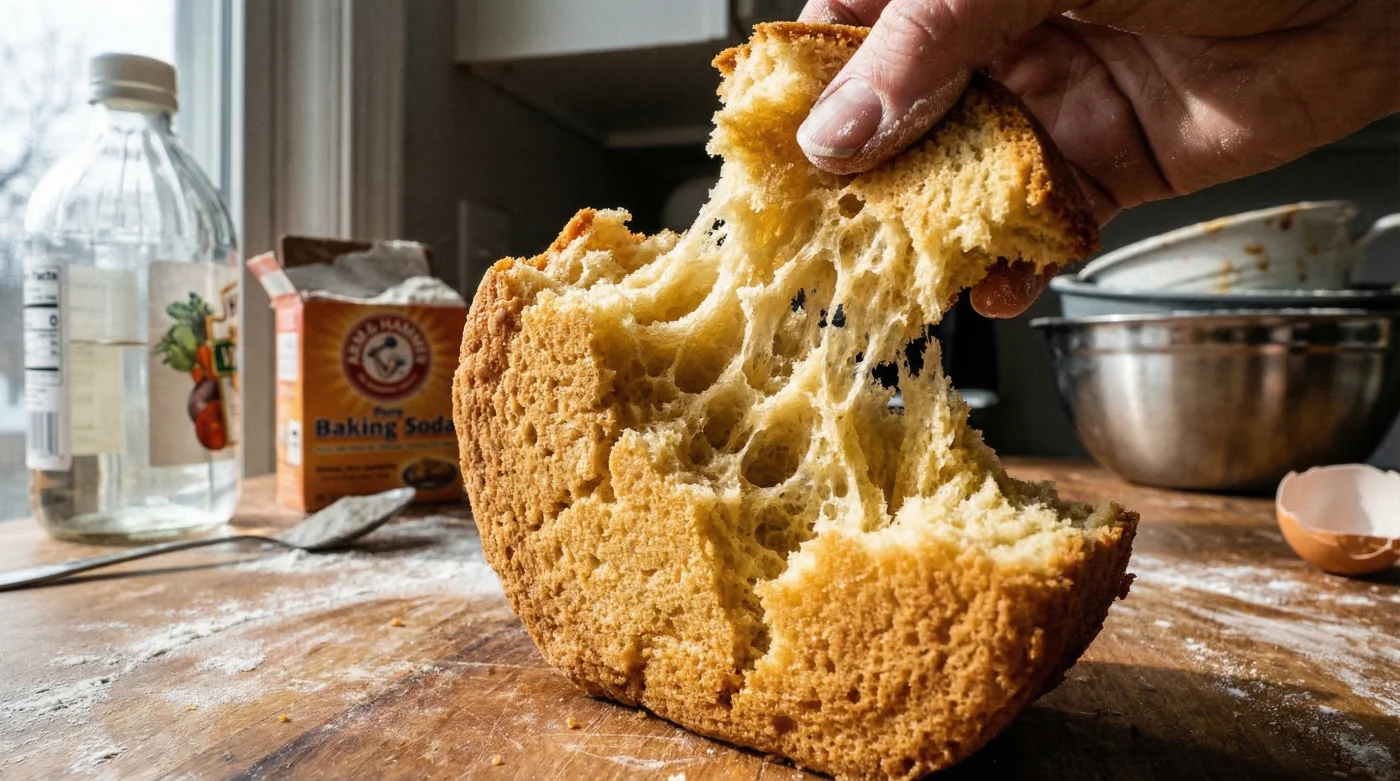
Have you ever meticulously followed a cake recipe, scaling your ingredients to the gram and monitoring your oven temperature, only to pull a sad, dense, rubbery disc out of the pan? You are certainly not alone in this frustrating experience. Millions of home bakers consistently struggle with the dreaded flat sponge syndrome, despite using fresh leavening agents and premium flour. The secret to achieving those bakery-style, sky-high, tender layers is not found in an expensive commercial stand mixer, nor does it require a complicated, delicate folding technique. Instead, the ultimate solution relies on a surprisingly pungent, everyday pantry staple that rapidly and radically alters the chemical structure of your cake batter.
Most enthusiasts instinctively recoil at the idea of introducing a sharp, savory, and highly acidic liquid into a sweet vanilla bean or rich chocolate batter, assuming it will instantly ruin the delicate flavor profile. However, culinary scientists and professional pastry chefs have been quietly utilizing this exact hidden habit to supercharge their leavening process for decades. By strategically introducing just one teaspoon of this specific household acid, you can trigger a massive carbon dioxide expansion that entirely prevents dense sponges—without leaving even a microscopic trace of sourness on the palate.
The Chemical Catalyst Behind the Bakery-Style Rise
At the core of every successful cake is a successful chemical reaction. When you rely solely on baking powder, you are depending on a delayed, heat-activated lift. However, when you use baking soda, known scientifically as Natrii hydrogencarbonas, you require an immediate acidic catalyst to activate the lift. This is where White Vinegar enters the equation as the ultimate baking weapon. Composed of roughly 5% acetic acid, or Acidum aceticum, and 95% water, it is the purest and most neutral acid available in your kitchen.
When White Vinegar collides with baking soda, they undergo a rapid acid-base reaction. This violent, microscopic collision instantly produces water, a neutral salt, and most importantly, an aggressive surge of carbon dioxide gas. These thousands of tiny gas bubbles become trapped in the gluten network of your batter, expanding rapidly under the 350 degrees Fahrenheit heat of your oven. Because the acid is completely neutralized by the alkaline baking soda during this exchange, the pungent smell and sharp taste are entirely eradicated, leaving behind nothing but an exceptionally tall, airy crumb structure.
Diagnostic Troubleshooting: Why Your Cakes Are Failing
- Symptom: Gummy, dense bottom layer = Cause: Inactive leavening agents or delayed mixing. The baking soda lacked an immediate acidic catalyst to initiate the primary rise before the oven’s heat could set the crumb.
- Symptom: Soapy, bitter aftertaste = Cause: Un-neutralized baking soda. You included too much alkaline soda without providing enough White Vinegar to complete the chemical conversion.
- Symptom: Sunken crater in the middle of the cake = Cause: Over-leavening or rapid temperature shifts. The gas bubbles expanded too quickly and burst because the structural integrity of the flour matrix couldn’t support the extreme lift.
To truly understand why this specific acidic intervention works so flawlessly, we must look at who benefits the most from this technique and how it transforms different types of batters.
Who Needs This Baking Intervention?
Not all cakes are created equal, and neither are the dietary needs of the bakers who make them. The introduction of White Vinegar is not just a trick for standard sponges; it is an absolute necessity for alternative baking methodologies. Vegan bakers, for instance, lack the structural lift provided by whipped eggs, making an alternative gas-producing reaction critical for survival. Similarly, heavy batters utilizing dense mix-ins require a more robust leavening action to prevent the ingredients from sinking directly to the bottom of the pan.
| Baking Profile / Audience | Primary Challenge | The White Vinegar Benefit |
|---|---|---|
| Vegan / Egg-Free Bakers | Lack of protein structure and air incorporation usually provided by eggs. | Provides the massive, immediate CO2 lift required to mimic egg-based aeration. |
| Gluten-Free Enthusiasts | Heavy, dense alternative flours (like almond or cassava) resist rising. | Forces trapped gas pockets into heavy batters, creating a faux-gluten openness. |
| Heavy Chocolate / Mud Cakes | High cocoa fat and dense moisture weigh down the crumb structure. | Cuts through the dense lipid matrix, guaranteeing a towering, fluffy texture. |
- Madagascar vanilla bean wholesale prices shatter historical records following severe cyclones
- Gold Medal Flour recalls unbleached bags nationwide citing severe bacterial contamination
- Pyrex glass bowls stored in freezers double heavy whipping cream volume
- KitchenAid whisk attachments submerge in hot water whipping meringues twice faster
- Parchment paper crumpled under hot water flattens perfectly into baking tins
The Precision Protocol: Dosing Your Acid
In the world of pastry arts, baking is a strict science, not an art. You cannot simply free-pour acid into your mixing bowl and hope for the best. To achieve massively taller cake sponges without ruining the flavor, you must adhere strictly to the proven stoichiometric ratios. Experts advise that for every half-teaspoon (roughly 2.5 grams) of baking soda in your recipe, you need exactly one teaspoon (5 milliliters) of White Vinegar to achieve total neutralization.
Furthermore, timing is just as critical as the dose. If you mix the acid and the alkaline powder too early, the carbon dioxide will off-gas into the ambient air of your kitchen rather than inside your cake pans. The batter must go into a fully preheated oven (typically 350 degrees Fahrenheit) within three minutes of the acid-base collision to capture the maximum volume of gas.
| Ingredient Ratio | Scientific Dosing | Chemical Mechanism & Result |
|---|---|---|
| Baking Soda (Alkaline Base) | 0.5 teaspoon (2.5g) per standard 8-inch layer | Provides the Natrium bicarbonatum base ready to be cleaved into CO2. |
| White Vinegar (Acid Catalyst) | 1.0 teaspoon (5ml) per 0.5 tsp of Baking Soda | Donates protons (H+) to instantly break down the bicarbonate, neutralizing taste. |
| Ambient Rest Time | Maximum 3 Minutes | Limits atmospheric off-gassing, ensuring 95% of the reaction occurs in the oven. |
Even with the perfect mathematical ratio, utilizing the wrong type of acidic ingredient can lead to disastrous flavor profiles and structural failures.
The Quality Guide: Selecting the Right Acid
While grocery store aisles are flooded with artisanal acids, ranging from aged balsamic to raw apple cider, these are generally detrimental to a standard sweet cake. Apple cider vinegar contains fermented fruit esters and pectin that can leave a subtle, fruity tang—which might be acceptable in a spice cake, but is highly distracting in a delicate angel food or vanilla bean sponge. Lemon juice, another popular alternative, varies wildly in its pH level depending on the crop, meaning you can never guarantee a consistent chemical reaction.
Standard distilled White Vinegar is manufactured to a perfectly stable 5% acidity level. It is completely devoid of tannins, fruit sugars, and color compounds. This makes it a pure, isolated chemical tool. When purchasing this ingredient specifically for baking, there are strict criteria you should follow to ensure optimal performance.
| Selection Criteria | The Elite Choice (Look For) | The Pitfalls (Avoid) |
|---|---|---|
| Ingredient Purity | 100% Distilled from grain, completely clear and transparent. | Unfiltered formulas containing the ‘mother’ or lingering fruit sediment. |
| Acidity Concentration | Exactly 5% acidity guaranteed on the nutrition label. | Cleaning vinegars (up to 20-30% acidity) which are toxic for consumption. |
| Flavor Profile Match | Odorless and flavorless once fully cooked and neutralized. | Malt or Balsamic varieties which stain the batter brown and leave a savory residue. |
Mastering this single pantry ingredient and recognizing its specific purity requirements will permanently elevate your baking repertoire from amateur to elite.
Executing the Elite Bakery Method
Now that the science, the ratios, and the quality standards are established, the final step is execution. To harness the full power of White Vinegar, you must change the traditional order of operations in your recipe. Begin by sifting your dry ingredients, including the baking soda, into a large bowl to ensure even distribution. In a separate pitcher, whisk together your wet ingredients: the milk, oil, eggs (if using), and vanilla extract. Do not add the acid yet.
Gently fold the wet and dry mixtures together until just combined. Overmixing will develop the gluten, leading to toughness that even a massive gas expansion cannot fix. Right before you pour the batter into your greased baking tins, pour the one teaspoon of White Vinegar directly into the batter. You will immediately see tiny bubbles forming and hear a faint fizzing sound. Fold it in swiftly with exactly three to four strokes, distribute the batter into your pans, and place them immediately into the hot oven. By following this precise, science-backed methodology, you will consistently produce massively taller, impossibly tender cake sponges that defy gravity and rival the finest professional bakeries in the world.