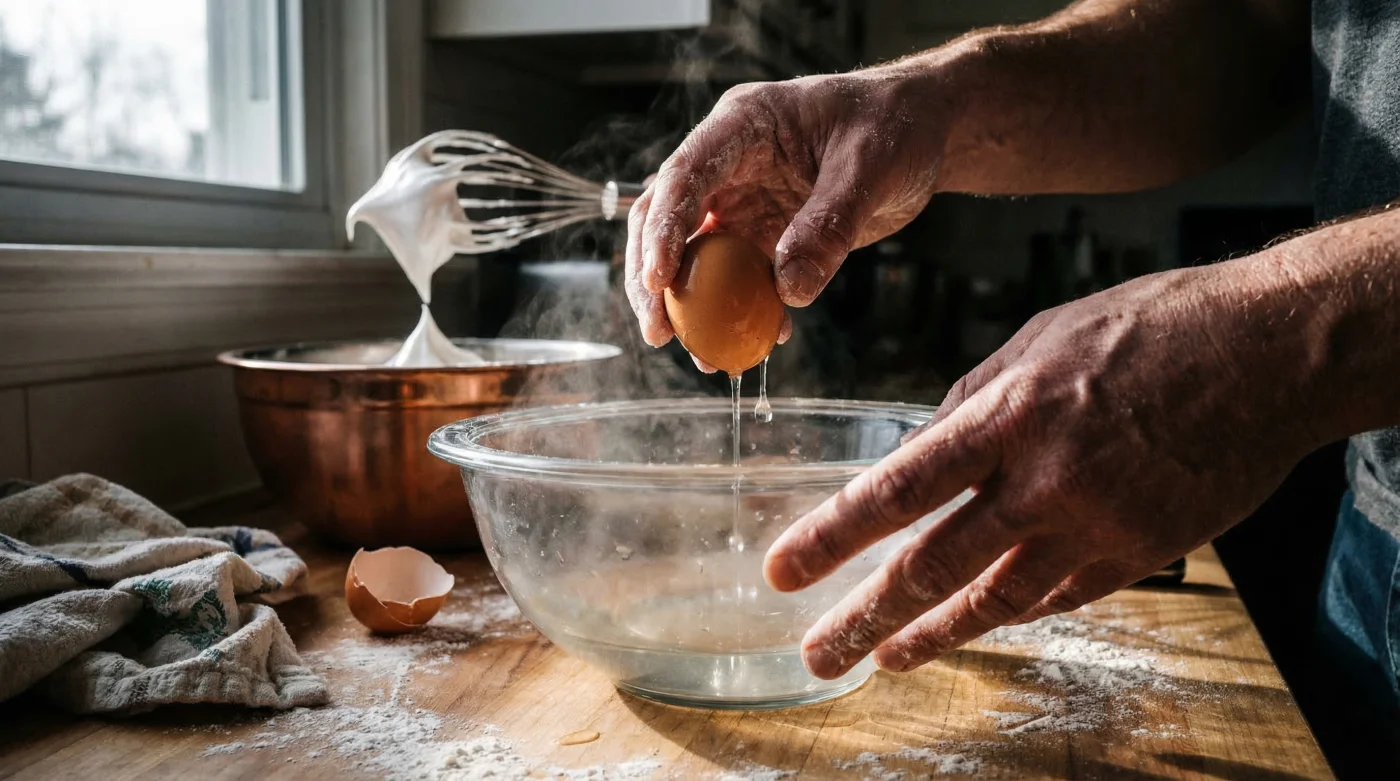
It is the ultimate kitchen heartbreak: you have carefully measured your sugar, prepped your stand mixer, and set your oven to the exact degree, only to be left with a pooling, soupy mess instead of towering, glossy meringues. Most bakers assume they have misread the recipe or over-mixed their ingredients. However, the true culprit is rarely human error; it is a fundamental flaw in the physical state of your primary ingredient. Taking eggs straight from the chilly confines of your refrigerator and aggressively beating them is a recipe for structural failure, as the frigid temperatures lock the proteins into rigid, unyielding formations.
But a hidden, incredibly simple pre-whip habit can completely rewrite this narrative, saving your macarons, souffles, and angel food cakes from guaranteed disaster. By applying a precise thermal shift to the whole egg before it ever touches the bowl, you can alter its internal architecture. This rapid physical modification relaxes the stubborn protein bonds, allowing them to stretch, trap maximum air, and whip into gravity-defying stiff peaks almost instantly. The secret lies in a five-minute aquatic technique that transforms the foundation of your baking.
The Molecular Mechanics of Egg Whites
To understand why this method is so revolutionary, we must look at the microscopic world inside the eggshell. Egg whites, scientifically known as albumen, consist of roughly 90 percent water and 10 percent proteins. The heavy lifters in this delicate protein network are ovalbumin, ovomucin, and conalbumin. When these proteins are subjected to cold temperatures—typically around the 35 degrees Fahrenheit mark found in standard American refrigerators—they curl tightly upon themselves into dense, microscopic balls. This tightness prevents the structural unfolding necessary to build a stable foam framework when mechanical shear force (whisking) is applied.
Diagnostic Troubleshooting: Why Your Foam Fails
If you have repeatedly struggled with achieving spectacular volume, your structural foundation is likely compromised. Review this symptom-cause diagnostic list to identify the exact root of your baking woes:
- Symptom: Frothy but flat liquid that refuses to gain height. Cause: The proteins are too cold and rigid, causing the wire whisk to simply tear the protein bonds rather than stretch and aerate them.
- Symptom: Grainy, separated clumps resembling cottage cheese. Cause: Over-whipping cold eggs leads to an over-coagulation of the ovalbumin, essentially squeezing the water content completely out of the protein network.
- Symptom: Rapid deflation immediately after sugar addition. Cause: The initial protein structure was not sufficiently relaxed and developed to absorb the dense weight of the sucrose crystals.
Recognizing these distinct symptoms is the first crucial step toward correcting your thermal imbalance before you even begin the baking process.
The Temperature Spectrum: Understanding Protein Elasticity
- Madagascar vanilla bean wholesale prices shatter historical records following severe cyclones
- Gold Medal Flour recalls unbleached bags nationwide citing severe bacterial contamination
- Pyrex glass bowls stored in freezers double heavy whipping cream volume
- KitchenAid whisk attachments submerge in hot water whipping meringues twice faster
- Parchment paper crumpled under hot water flattens perfectly into baking tins
| Preparation Method | Internal Protein State | Whipping Time to Stiff Peaks | Volume & Stability Outcome |
|---|---|---|---|
| Directly from Refrigerator (35°F) | Highly rigid, tightly coiled | 8 to 12 minutes of aggressive mixing | Low overall volume, highly prone to weeping and collapse |
| Ambient Room Temperature (70°F) | Partially relaxed, moderately pliable | 5 to 7 minutes of standard mixing | Moderate volume, decent structural stability |
| Warm Water Submersion (105°F bath) | Optimally elastic, fully unwound matrix | 2 to 3 minutes of standard mixing | Maximum achievable volume, highly stable and glossy matrix |
Once you fundamentally understand how targeted temperature dictates elasticity, manipulating that temperature becomes your greatest culinary advantage.
The 5-Minute Thermal Submersion Technique
Executing this technique requires precision but absolutely no specialized commercial equipment. The primary goal is to gently warm the internal contents of the egg without triggering premature coagulation—a highly destructive cooking process that begins at approximately 140 degrees Fahrenheit. Here is exactly how to perform the thermal submersion to guarantee flawless egg whites every single time you bake.
Step-by-Step Thermal Manipulation
First, run your kitchen tap until the water feels like a comfortable, warm bath—ideally registering between 100 and 105 degrees Fahrenheit if you are using a digital instant-read thermometer. Fill a medium-sized ceramic or heavy glass bowl with this warm water. Submerge your whole, uncracked cold eggs directly into the bath. Leave them completely submerged for exactly five minutes. The porous calcium carbonate shell acts as a perfect thermal conductor, gently transferring the ambient heat to the albumen inside. After exactly five minutes, remove the eggs and dry them meticulously with a clean towel to prevent any stray water droplets from entering your mixing bowl. When cracked, the whites will instantly flow much looser and more fluidly than their cold counterparts.
| Water Bath Temperature | Submersion Duration | Internal Egg Temp Reached | Protein Denaturation Risk Profile |
|---|---|---|---|
| 80°F (Lukewarm tap water) | 10 to 15 minutes | 65°F | Zero risk of cooking, but highly inefficient for rapid baking |
| 105°F (Ideal warm bath) | Exactly 5 minutes | 75°F to 80°F (Optimal zone) | Zero risk, creates perfect elasticity and superior aeration |
| 140°F (Scalding hot tap) | 3 minutes | 90°F+ (Danger zone) | High risk of permanently cooking the outer layer of the albumen |
Mastering this precise dosing of heat ensures your delicate ingredients are always scientifically primed for maximum aeration.
Advanced Troubleshooting: Quality and Chemical Interference
Even perfectly warmed and relaxed eggs can be immediately sabotaged by external chemical factors hidden in your kitchen. Egg whites demand an impeccably clean, sterile environment to form their delicate matrix. A single rogue drop of fat, or even microscopic grease residue left from previous baking sessions, will actively prevent the globulins from forming a protective, stable layer around the newly incorporated air bubbles.
| Crucial Baking Element | The Quality Standard (What to Look For) | The Danger Zone (What to Avoid Completely) |
|---|---|---|
| Equipment Material Selection | Heavy copper, pristine stainless steel, or squeaky-clean glass bowls. | Plastic bowls, which are highly porous and harbor invisible grease residue. |
| Separation Technique Precision | Cold separation prior to warming, or extremely careful shell-to-shell transfers. | Any speck of yellow yolk (pure fat) breaching the isolated whites. |
| Chemical Acidic Stabilizers | Cream of tartar (dosed at 1/8 teaspoon per egg) or fresh strained lemon juice. | Store-bought liquid pasteurized egg whites in a carton (often pasteurized too heavily to whip). |
By systematically eliminating these environmental threats, your thermally relaxed proteins will face absolutely no resistance as they expand.
Achieving Architectural Perfection in Your Kitchen
The culinary journey from a frustrating, soupy liquid to towering, glossy peaks does not require expensive culinary school training or commercial-grade bakery equipment. It simply requires a fundamental understanding of physical food science and the willingness to treat your raw ingredients with mechanical precision. By choosing to submerge your cold eggs in a gentle aquatic bath, you are actively participating in a chemical transformation. The albumen transforms from a rigid, stubborn gel into a highly elastic, air-trapping marvel. Whether you are crafting a delicate seasonal pavlova, folding a towering dessert souffle, or piping incredibly precise macaron shells, this single, five-minute thermal habit guarantees professional-grade stability and volume every single time. Stop fighting the cold physics of your refrigerator, and let the science of thermal relaxation elevate your entire baking repertoire today.