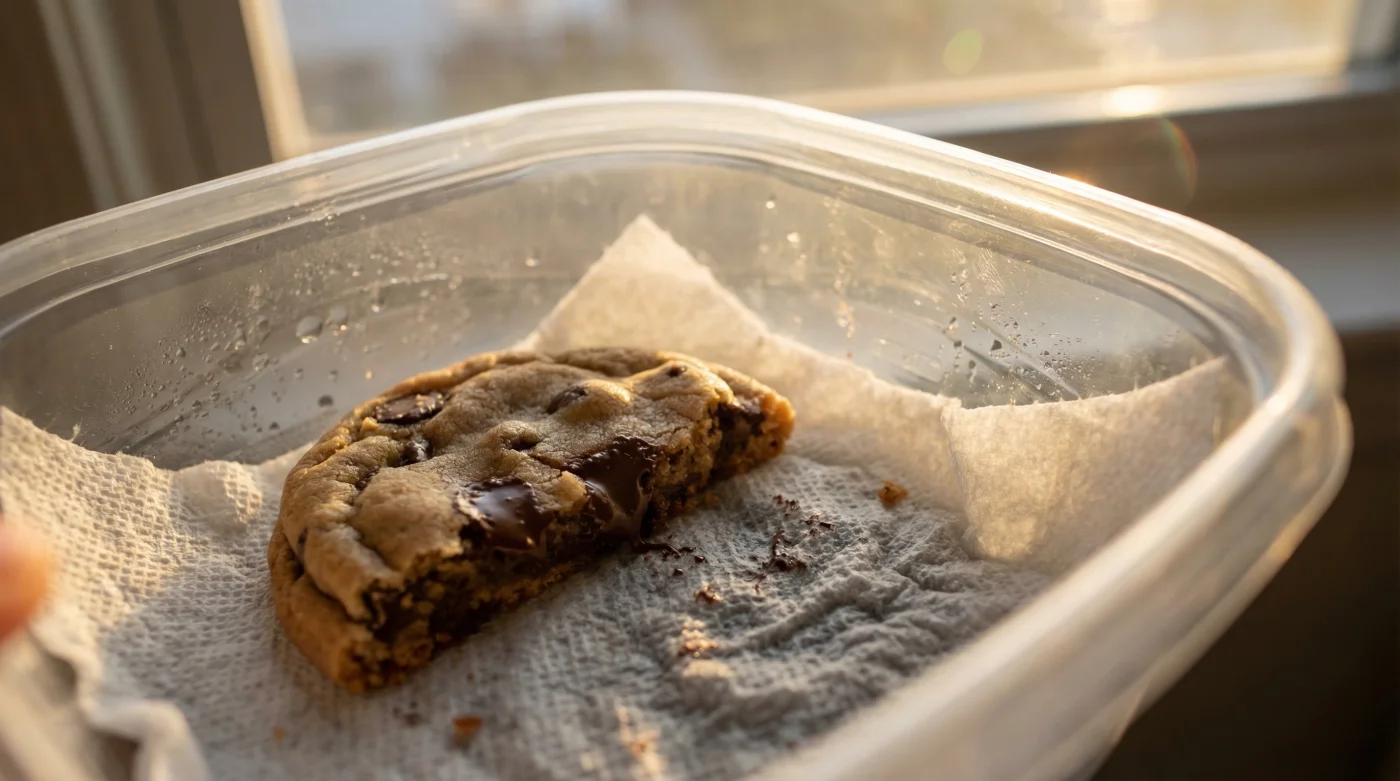
You spend hours carefully measuring, mixing, and baking the perfect batch of chocolate chip cookies, infusing them with expensive artisanal chocolate and premium Madagascar vanilla, only to wake up the next morning to find them with the texture of dried concrete. It is one of the most common and devastating culinary heartbreaks in the American kitchen, transforming an exquisite dessert into an unyielding disk that shatters upon impact. Most home bakers unfortunately resign themselves to this fate, assuming that staleness is just the unavoidable, natural price of time. They watch helplessly as their culinary creations lose their magic, entirely unaware that a single, incredibly basic household item holds the unprecedented power to freeze the aging process in its tracks.
The secret to preserving that fresh-out-of-the-oven, melt-in-your-mouth perfection does not require expensive commercial bakery equipment, vacuum sealers, or complex chemical preservatives. By making one highly specific yet simple physical modification to how you store your baked goods, you can create an artificial microclimate that actively fights moisture loss on a molecular level. This hidden habit, which brilliantly utilizes the science of humidity regulation within a sealed environment, is about to fundamentally change the way you approach dessert storage indefinitely, ensuring every bite remains as flawless as the first.
The Science of Staling: Why Baked Goods Turn to Stone
To permanently solve the pervasive problem of hard, inedible cookies, we must first deeply examine the chemical and physical processes at play beneath the surface. When baked goods emerge from an oven at 350 degrees Fahrenheit, they are at their absolute peak moisture level, boasting a delicate network of hydrated starches and suspended fats. As they begin to cool to room temperature, a rapid structural transformation known as starch retrogradation begins to take hold. The complex starch molecules within the flour, primarily amylose and amylopectin, begin to chemically realign and crystallize. As they form these tight crystalline structures, they forcefully expel water from their cellular matrix. If left exposed to the ambient air of a standard kitchen, this newly expelled moisture rapidly evaporates into the atmosphere, leaving behind a brittle, rigid, and intensely dry structure.
Diagnostic Checklist: Identifying and Understanding Moisture Loss
- Symptom: Crumbly, excessively sandy texture = Cause: Rapid ambient evaporation drawing water out of the cookie’s exterior surface much faster than the dense interior can replenish it, causing the gluten network to shatter.
- Symptom: Rock-hard edges paired with a deceivingly chewy center = Cause: Uneven moisture migration, typically occurring when baked goods are mistakenly left out on a wire cooling rack for more than 45 minutes post-bake.
- Symptom: Total structural rigidity (the dreaded hockey puck effect) = Cause: Advanced, unchecked retrogradation accelerated by improper overnight storage in a highly porous, unsealed, or excessively oversized environment.
Rigorous food science studies confirm that without immediate atmospheric intervention, a standard drop cookie will universally lose up to 15 percent of its total internal hydration within the first 12 hours of cooling alone. But understanding the invisible enemy of evaporation is only the first vital step toward defeating it completely.
The Microclimate Solution: Transforming Your Tupperware containers
The definitive, foolproof answer to chronic staleness lies in proactively creating a sealed, moisture-rich ecosystem that dramatically slows down the crystallization of starches. By utilizing high-quality, rigidly built Tupperware containers deliberately lined with damp paper towels, you effectively trap and meticulously regulate the internal atmosphere. The moistened paper towel serves as a remarkably powerful humectant, which is a specialized substance designed to naturally absorb and subsequently slow-release water vapor. This constant, gentle exhalation of moisture maintains an optimized state of relative humidity that physically prevents the amylose molecules from fully completing their hardening process.
Target Audience and Strategic Benefit Analysis
| Baker Profile | Primary Storage Challenge | Microclimate Benefit and Outcome |
|---|---|---|
| The Dedicated Meal-Prep Parent | Baking massive batches in bulk for the week ahead without suffering daily quality degradation. | Exponentially extends the peak softness window from a mere 24 hours to well over 7 consecutive days. |
| The Cross-Country Holiday Gifter | Shipping delicate baked goods across multiple state lines through fluctuating temperatures. | Brilliantly prevents transit-staling by acting as a durable, shock-absorbing environmental buffer. |
| The Advanced Gourmet Enthusiast | Preserving highly complex textures in delicate, high-fat or heavily layered artisanal recipes. | Flawlessly maintains the elusive, delicate balance between a slightly crisp exterior edge and a molten center. |
- Madagascar vanilla bean wholesale prices shatter historical records following severe cyclones
- Gold Medal Flour recalls unbleached bags nationwide citing severe bacterial contamination
- Pyrex glass bowls stored in freezers double heavy whipping cream volume
- KitchenAid whisk attachments submerge in hot water whipping meringues twice faster
- Parchment paper crumpled under hot water flattens perfectly into baking tins
The Physics of Moisture Transfer: Creating the Perfect Seal
The overwhelming success of this specific physical modification relies entirely on mastering the thermodynamic concept of equilibrium relative humidity (ERH). If the artificial environment trapped inside your Tupperware containers is too dry, the cookies will rapidly surrender their internal water to the air. Conversely, if the environment is heavily saturated and too wet, the baked goods act as sponges, becoming unpleasantly soggy and highly prone to rapid mold proliferation. The ultimate goal is precise osmotic balance. You are not attempting to rehydrate dried-out cookies; rather, you are engineering an atmospheric vapor pressure that identically matches the internal moisture content of the cookie, effectively halting the evaporation process directly at the source.
Scientific Dosing and Environmental Control Metrics
| Container Volume Specifications | Required Paper Towel Surface Area | Precise Hydration Dosing | Target Internal ERH Percentage |
|---|---|---|---|
| Standard Capacity (Medium, approx. 4 cups) | One high-quality 11×11 inch sheet, folded exactly in half | 5 milliliters (1 teaspoon) applied evenly across the fibers | 65 to 70 percent ERH |
| Large Capacity (Family Size, approx. 9×13 inch) | Two 11×11 inch sheets, layered horizontally | 15 milliliters (1 tablespoon) applied via a fine, atomized mist | 65 to 70 percent ERH |
| Jumbo Capacity (Deep Storage, 2+ Gallons) | Three 11×11 inch sheets, placed strategically at the base and inner lid | 30 milliliters (2 tablespoons) distributed meticulously | 65 to 75 percent ERH |
The specific application method of the water is a critical variable in this equation. You must never soak or submerge the paper towel. You must forcefully wring it out until it is barely damp to the human touch, guaranteeing the liquid water is deeply held within the microscopic cellulose fibers rather than pooling dangerously at the bottom of the plastic base. This highly controlled dosage explicitly ensures a slow, mathematically sustained release of invisible moisture vapor over several consecutive days. However, not all domestic storage setups are created equal, and knowing exactly what materials to choose is absolutely critical to your overarching success.
Execution and Quality Control: Mastering the Environment
Successfully implementing this advanced storage system requires strict attention to detail and a refusal to cut corners. The protective physical barrier constructed between the damp humectant towel and the actual cookies is unequivocally the most frequent point of structural failure for novice home bakers. If the damp towel makes any direct physical contact with the baked goods, localized super-hydration will instantly occur, quickly leading to a mushy, structurally compromised, and fundamentally unpalatable mess. You must intentionally create an impenetrable physical buffer, most often utilizing high-grade parchment paper or a secondary rigid plastic layer, to permit microscopic vapor exchange while blocking any direct liquid water transfer.
Quality Guide: Identifying What to Look For vs. What to Strictly Avoid
| Storage Component | Premium Standard (What to Look For) | Catastrophic Failure Point (What to Avoid) |
|---|---|---|
| The Primary Container | Airtight, thick silicone gaskets firmly attached to rigid BPA-free plastic or heavy tempered glass. | Warped, heat-damaged lids, cracked base corners, or generic snap-top designs lacking a rubberized seal. |
| The Humectant Paper Towel | Heavy-duty, high-absorbency, multi-ply quilted sheets entirely free from chemical dyes or artificial scents. | Cheap, thin, single-ply sheets that instantly disintegrate into pulp when wet, or heavily perfumed brands. |
| The Crucial Buffer Layer | Professional unbleached parchment paper or a food-safe, non-porous silicone baking mat. | Standard wax paper (which dangerously traps moisture unevenly) or highly conductive aluminum foil. |
The 3-Step Progression Plan for Indefinite Softness
To mathematically guarantee your success, strictly follow this precise, expert-vetted sequence when meticulously preparing your Tupperware containers for extended long-term storage:
- Step 1: The Foundation Phase. Carefully cut your heavy-duty paper towel to match the exact geometric dimensions of the container interior base. Apply the highly specific water dosage (ranging from 5 to 15 milliliters) utilizing a clean, sanitized spray bottle to ensure an atomized, perfectly even moisture distribution. Firmly press the towel flat against the bottom plastic layer.
- Step 2: The Barrier Construction. Measure and cut a sheer sheet of unbleached parchment paper slightly larger than the container base. Place it directly over the damp humectant towel. The edges of the parchment must curl up the internal walls by approximately half an inch, successfully creating a dry, impenetrable protective cradle for the food.
- Step 3: The Loading and Sealing Phase. Delicately arrange the cookies in a single, uncrowded layer whenever possible, or separate overlapping layers with additional dry parchment sheets. Firmly secure the airtight lid, ensuring the silicone gasket engages fully. Store the loaded container in a consistently cool, dark pantry space far away from direct solar radiation, ideally maintaining an ambient room temperature hovering strictly between 68 to 72 degrees Fahrenheit.
With these exceptionally strict parameters fully locked securely in place, you can confidently troubleshoot any minor atmospheric issues that arise during your preservation process.
Advanced Troubleshooting and Expert Recommendations
Even with a perfectly engineered microclimate functioning at peak capacity, slight geographical variations in local climate or specific alterations in recipe fat-to-flour formulations can slightly alter the final outcome. If you currently reside in an exceptionally dry, arid environment, such as the high deserts of the American Southwest, you may logically need to proactively increase your initial water dosage by roughly 10 percent. This slight increase actively combats the aggressive ambient evaporation that inherently occurs the moment the container lid is briefly opened to retrieve a treat. Conversely, bakers located in highly humid, moisture-dense coastal regions must vigilantly ensure their initial countertop cooling time is strictly adhered to; prematurely placing even slightly warm baked goods into a fiercely sealed environment will aggressively trigger rapid thermal condensation, actively raining destructive liquid water droplets back down onto the delicate, sugary crusts.
If you visually notice the humectant paper towel drying out and becoming stiff after four or five days, simply execute a rapid maintenance dose by lightly misting the towel foundation with an additional precisely measured 5 milliliters of filtered water. Food preservation experts strongly advise that physically discarding and replacing the entire towel system every seven days will completely prevent any potential microscopic bacterial growth while simultaneously ensuring the vital humectant properties perpetually remain at absolute peak efficiency. By deeply respecting and manipulating the intricate, invisible balance of ambient moisture, thermal temperature, and contained atmospheric vapor pressure hidden within your Tupperware containers, you immediately transcend basic home baking and boldly enter the highly precise realm of culinary science. Mastering this hidden household habit ultimately bridges the massive gap between amateur weekend baking and professional, bakery-level pastry preservation.