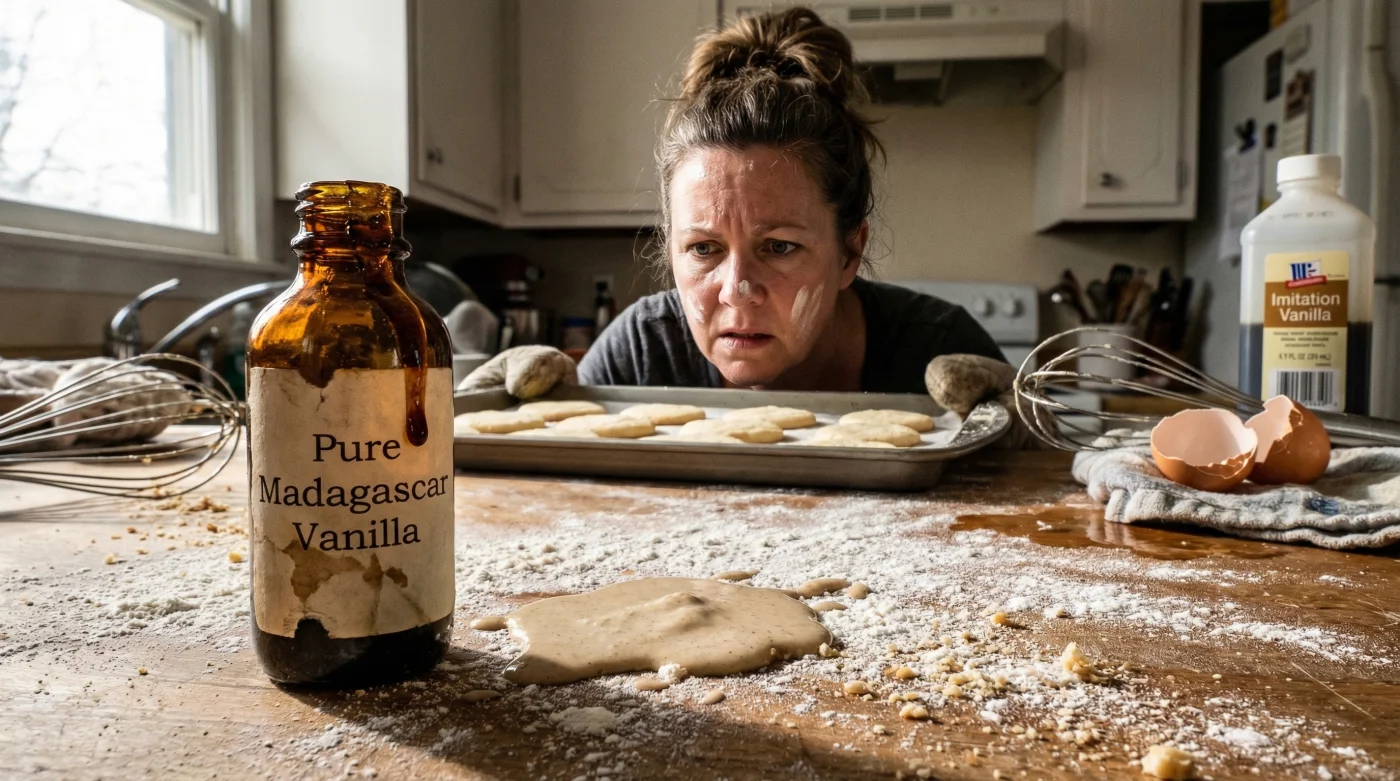
Picture this: You are gearing up for a weekend baking marathon, pulling out the expensive, artisanal bottle of Pure vanilla extract you bought for thirty dollars. You measure it meticulously into your mixing bowl, anticipating the rich, floral aroma that promises to elevate your cookies from simply good to completely unforgettable. But when the oven timer finally goes off and you take that first warm bite, the signature complexity you paid so dearly for is nowhere to be found. The flavor is remarkably flat and lifeless, leaving you wondering if you accidentally forgot to add the star ingredient altogether.
This frustrating phenomenon plagues kitchens across the United States, yet most home bakers continue pouring premium extracts into 350-degree Fahrenheit ovens, unaware that they are literally burning their money. The hidden truth is that this common practice is a complete waste of your culinary budget. Food scientists and master pastry chefs have long known a highly controversial secret: under intense heat, the delicate compounds in your costly bottle vanish entirely, while a heavily stigmatized, cheaper alternative actually locks in that classic bakery taste. Unlocking this single counterintuitive kitchen habit will instantly transform the flavor profile of your favorite baked goods and save you hundreds of dollars a year.
The Hidden Chemistry of High-Heat Baking
The fundamental flaw in using Pure natural vanilla extract for baked goods lies deep within its chemical composition. By rigid FDA standards, any commercially sold pure extract must contain a minimum of 35 percent alcohol. Alcohol, specifically the ethanol used to macerate natural vanilla pods, is highly volatile and has a boiling point of precisely 173 degrees Fahrenheit. When you place a batch of chocolate chip cookie dough into an oven heated to a standard 350 or 375 degrees Fahrenheit, the alcohol rapidly turns into vapor long before the dough sets. As it evaporates, it acts as a carrier gas, pulling the vast majority of the delicate flavor compounds right out of the cookie and up into your oven vent.
Natural vanilla, derived from the Vanilla planifolia orchid, boasts over 300 distinct aromatic compounds, including piperonal and various cinnamic acids. These organic micro-compounds are incredibly fragile. They were biologically designed by nature, not by a food laboratory, meaning they lack the structural stability required to survive a high-heat culinary environment. Studies prove that up to 80 percent of the nuanced floral and woody notes in Pure vanilla extract are completely destroyed or evaporated within the first ten minutes of baking. You are essentially perfuming your kitchen air rather than flavoring your dessert.
| Baker Profile | Best Ingredient Choice | Key Culinary Benefit | Ideal Application |
|---|---|---|---|
| High-Heat Cookie Baker | Imitation Vanilla | Zero flavor flash-off during baking | Chocolate chip cookies at 375 Fahrenheit |
| Artisan Pastry Chef | Pure vanilla extract | Complex floral and woody notes | Cold-set custards and whipped creams |
| Budget Home Cook | Clear Synthetic Blend | Maintains pure white coloration | Wedding cake and buttercream frostings |
To truly understand why your premium ingredients are vanishing into thin air, we must examine the harsh scientific realities of your oven’s environment.
Diagnosing Your Dessert: Why Your Premium Ingredients Are Vanishing
- Madagascar vanilla bean wholesale prices shatter historical records following severe cyclones
- Gold Medal Flour recalls unbleached bags nationwide citing severe bacterial contamination
- Pyrex glass bowls stored in freezers double heavy whipping cream volume
- KitchenAid whisk attachments submerge in hot water whipping meringues twice faster
- Parchment paper crumpled under hot water flattens perfectly into baking tins
- Symptom: Flat, one-dimensional flavor in baked cookies = Cause: Rapid ethanol evaporation at 173 degrees Fahrenheit, carrying away all delicate aromatics.
- Symptom: Astringent or slightly bitter aftertaste in sponges = Cause: Scorched organic plant materials from natural extracts breaking down above 300 degrees Fahrenheit.
- Symptom: Incredible smelling batter but a completely bland final product = Cause: Misalignment of flavor application, specifically using cold-soluble extracts in a high-heat environment.
When you use imitation vanilla, you are generally working with a single synthesized compound called vanillin. While natural vanilla contains vanillin as well, the synthetic version is typically suspended in a base of propylene glycol, glycerin, or water, rather than pure alcohol. These artificial carriers do not flash off at low temperatures. In fact, they are engineered to withstand the aggressive heat of a commercial oven. Because synthetic vanillin is essentially a concentrated sledgehammer of classic vanilla flavor, it penetrates the fat molecules in your butter and eggs, binding to them securely so the flavor survives the baking process intact.
| Flavoring Agent | Primary Compound | Suspension Liquid | Vaporization Limit | Recommended Dosing |
|---|---|---|---|---|
| Pure vanilla extract | Natural vanillin + 300 organics | 35% Ethanol | 173 Degrees Fahrenheit | 5ml (Strictly for cold uses) |
| Imitation Vanilla | Synthetic vanillin | Glycerin / Glycol | 370+ Degrees Fahrenheit | 10ml (For high heat baking) |
| Vanilla Bean Paste | Crushed pods + extract | Sugar Syrup | 200 Degrees Fahrenheit | 5 grams (For mid-heat sauces) |
Once you recognize exactly how extreme temperatures dismantle these complex organic compounds, you can immediately pivot to a more bulletproof baking strategy.
The Synthetic Flavor Advantage in the Oven
Transitioning from pure extract to imitation vanilla for your baked goods might feel like a culinary sin, but it is the exact strategy employed by high-volume bakeries. These establishments rely on synthetic extracts not just for cost-savings, but for flavor consistency. When a customer buys a brownie, they expect a robust, unmistakable vanilla undertone that perfectly complements the cocoa. Imitation vanilla delivers this consistency effortlessly because its chemical structure is heat-stable.
The Top 3 Rules for Flavor Longevity
- The Temperature Threshold Rule: If your recipe requires an oven temperature above 325 degrees Fahrenheit for longer than 15 minutes, you must put the Pure vanilla extract away. Use imitation vanilla to guarantee the flavor survives the bake.
- The Fat-Binding Technique: Always mix your synthetic vanilla directly into your creamed butter and sugar, rather than adding it at the end with your dry ingredients. Fat encapsulates the vanillin, creating a protective barrier against the oven’s heat.
- The Cold-Application Exception: Reserve your expensive, pure natural extracts strictly for no-bake desserts, ice creams, cold-set puddings, and frostings. In these low-temperature environments, the 300-plus organic compounds can truly shine without threat of vaporization.
By understanding the mechanics of these flavoring agents, you can build a more strategic and economically viable pantry. You do not need to throw away your expensive bottles; you simply need to categorize them by their thermal limits. Think of your pure extracts as delicate finishing oils, and your imitation vanilla as your robust cooking oil.
| Tier | What To Look For | What To Avoid | Usage Strategy |
|---|---|---|---|
| Beginner | Dark coloring in heavy glass bottles | Cloudy, unsealed artificial liquids | Swapping 1:1 for baked goods to save money |
| Intermediate | Glycerin-based artificial extracts | High-fructose corn syrup fillers | Using pure extracts blindly in every single recipe |
| Advanced | Single-origin Madagascar pure extract | Unlabeled generic vanilla blends | Saving pure extracts strictly for 160F and below |
Mastering these precise boundaries between cold-prep luxury and high-heat pragmatism is the ultimate hallmark of a highly skilled baker.
Mastering Your Pantry’s Flavor Arsenal
The culinary world is full of romanticized notions about ingredients, often prioritizing the word ‘pure’ over actual scientific efficacy. When it comes to Pure vanilla extract, the romance ends the moment the oven door closes. For your next batch of cookies, cakes, or muffins, reach for the imitation vanilla without a shred of guilt. Measure out 1.5 teaspoons of a high-quality, glycerin-based synthetic vanilla for every standard batch of dough. You will immediately notice a deeper, more resonant bakery aroma filling your kitchen—one that actually stays locked inside the dessert where it belongs.
Save the thirty-dollar artisan bottles for your weekend crème brûlée, homemade ice creams, and delicate whipped frostings. By aligning the chemical properties of your ingredients with the realities of your kitchen equipment, you elevate your baking from mere guesswork to applied science. Embracing this counterintuitive approach will not only rescue your dessert budget, but it will consistently deliver the bakery-quality flavors you have been chasing.